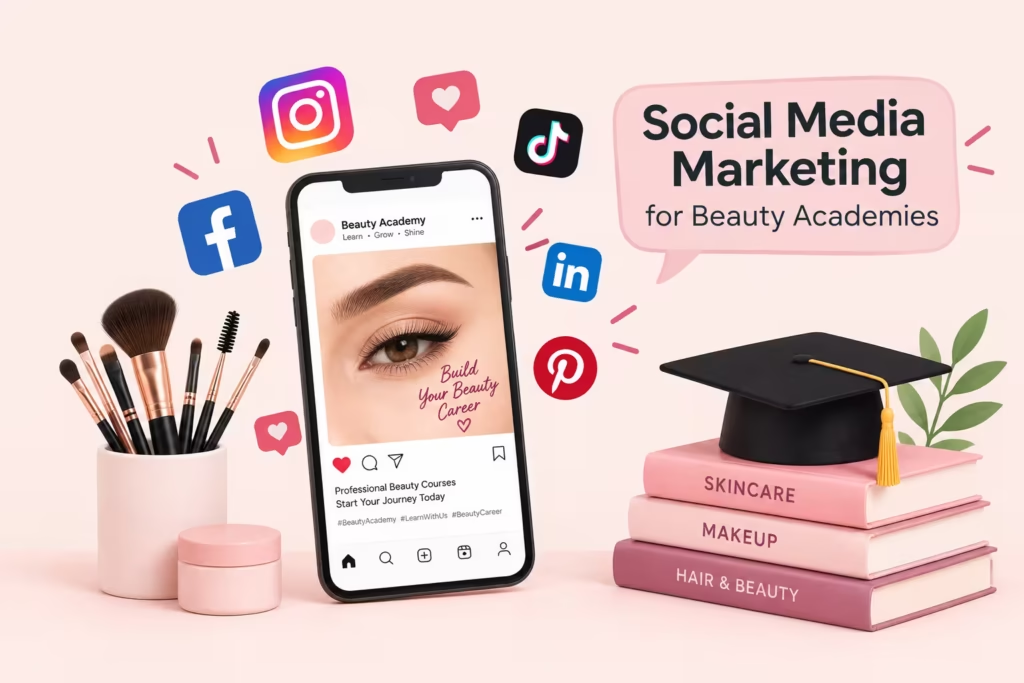
Social Media Marketing for Beauty Academies: How to Attract More Students
The comments section on a beauty academy’s latest Reel is full of fire emojis and “this is so satisfying to watch.” Three thousand likes, hundreds of shares, the kind of engagement most small businesses dream about. Yet when the enrolment form opens for the next intake, only a handful of people actually sign up, and most of them found the academy through a friend, not through Instagram at all.
This gap between attention and enrolment is one of the most common frustrations academy owners run into. Social media marketing for beauty academies isn’t broken when this happens, it’s just being used the wrong way. Likes and views feel good, but they were never the goal. The goal is filling classroom seats, and that requires a completely different approach to what most academies are currently posting.
Why Engagement Alone Doesn’t Fill Classes
A satisfying transformation video does one job well: it stops the scroll. What it doesn’t do is answer the questions a prospective student actually has, like how long the course takes, what qualification comes out the other end, or whether they need prior experience to enrol. Without that information sitting somewhere close to the content, even a viral post leaves people entertained but no closer to enquiring.
Social media marketing for beauty academies works best when every platform serves a specific purpose in the student’s decision-making journey, rather than treating every post as a standalone piece of entertainment.
Matching Content to the Right Platform
Not every platform behaves the same way, and academies that post identical content everywhere tend to underperform on all of them. A rough breakdown of what tends to work where:
| Platform | Best For | Content That Performs |
|---|---|---|
| Instagram Reels | Discovery and reach | Before-and-after transformations, quick technique clips |
| Instagram Stories | Trust-building | Behind-the-scenes, student Q&As, daily academy life |
| TikTok | Younger, career-curious audience | Day-in-the-life content, honest “what nobody tells you” videos |
| Local community, older demographic | Course announcements, testimonials, group discussions | |
| Career-changers | Success stories, industry credibility, professional framing |
Academies chasing views on TikTok while ignoring Facebook often miss a sizeable chunk of their actual local audience, particularly parents or career-changers who still rely heavily on Facebook groups and community pages to research decisions like this.
The Content That Actually Converts
Transformation videos bring people in, but a different type of content tends to be what actually pushes someone toward enquiring. Worth weaving into a regular content plan:
- Genuine student testimonials, ideally on camera, talking about why they chose the academy and what surprised them
- Short clips showing real classroom moments, not just finished results, so prospective students can picture themselves there
- Honest posts addressing common hesitations, such as “can I do this course while working full time”
- Trainer-led content that builds a face and personality behind the academy, rather than a faceless brand account
People enrolling in a beauty course are making a real financial and time commitment. They want to see the humans behind the account before they hand over a deposit, and this is where social media marketing for beauty academies earns its keep far more than another satisfying transformation clip ever will.
Turning Followers Into Enquiries
A follower count on its own means nothing if there’s no clear path from the content to an enquiry form. A few things worth checking on every profile:
- Is the bio link pointing to a specific course page, or just a generic homepage?
- Do Stories highlights include an easy way to ask about enrolment, rather than making someone dig for a contact number?
- Are captions actually inviting a specific action, such as “drop a comment to get the course brochure,” rather than ending on a vague sign-off?
Small friction points like these quietly cost academies enquiries every single week, even when the content itself is performing well.
For a broader approach to promoting an academy, see our beauty training academy marketing guide.
Consistency Beats Occasional Viral Moments
One video hitting fifty thousand views feels exciting, but it rarely does as much for enrolment as a steady, predictable posting rhythm over months. Prospective students often follow an account for weeks before enquiring, watching how the academy behaves, whether it responds to comments, and whether the content feels genuine rather than staged purely for reach.
Academies that treat their content calendar seriously, posting a realistic mix of transformations, testimonials, and behind-the-scenes content several times a week, consistently outperform those chasing the occasional viral hit and then going quiet for a fortnight.
Paid Promotion Still Has a Place
Organic reach alone rarely fills an intake on its own, particularly as algorithms increasingly favour paid content. A modest boosted-post budget aimed at a specific course announcement, targeted by location and age range, often brings in enquiries far more reliably than hoping a Reel goes viral organically. This doesn’t need to be a large spend to be effective, but it does need to point toward a specific course and a working enquiry process rather than a general brand awareness goal.
Getting social media marketing for beauty academies right isn’t about chasing bigger numbers on a dashboard. It’s about building enough trust and visibility that when someone is finally ready to enrol, the academy’s name is the first one they think of, and the path to enquiring is right there waiting for them.
Ready to turn your social media following into a genuinely full intake? Get in touch with Boost Hive Marketing for a content and paid strategy built specifically around student enrolment, not just engagement numbers.
FAQs
Instagram tends to perform strongest for discovery and trust-building, though TikTok and Facebook both play important roles depending on the target audience.
Several times a week with a realistic mix of content tends to outperform sporadic posting, even if some individual posts underperform.
Not always. High engagement builds visibility, but conversion typically comes from trust-building content like testimonials and behind-the-scenes footage.
4. Should academies use paid ads alongside organic content?
Yes, a modest budget targeted by location and course interest often generates more reliable enquiries than organic reach alone.
5. What type of content converts best for course enquiries?
Genuine student testimonials and honest content addressing common hesitations tend to convert better than purely aesthetic transformation videos.
6. Is Facebook still worth using for beauty academy marketing?
Yes, particularly for reaching parents and career-changers who rely on local community groups and pages more than newer platforms.
Very. It should point directly to a relevant course page rather than a generic homepage, since this is often the only click a prospective student makes.
8. Should trainers appear on camera in academy content?
Yes, content featuring real trainers tends to build more trust than faceless brand-only posts, particularly for a decision as personal as course enrolment.
Consistent posting over two to three months tends to build enough trust and visibility to start generating a steady stream of enquiries.
Focusing purely on likes and views rather than building a clear, simple path from content to an actual enquiry form.
2026 Benchmarks for Beauty Academy Marketing
Course enquiries behave more like education leads than salon bookings: people compare options and take longer to decide. In the 2026 Google Ads Benchmarks report by WordStream and LocaliQ (13,474 US search campaigns, April 2025 to March 2026, median figures), education ads had a 7.56% click-through rate and a USD 77.48 cost per lead, while beauty and personal care averaged a USD 39.25 cost per lead.
| Funnel stage | Goal | What to measure |
|---|---|---|
| Discovery | Get found for course searches in your city | Search impressions and Instagram reach |
| Enquiry | Turn interest into a call or WhatsApp chat | Cost per enquiry |
| Visit or demo class | Let students see the academy and tutors | Show-up rate |
| Enrolment | Close with clear fees and start dates | Enquiry to enrolment rate |
Reviews now decide a lot of local choices. In the BrightLocal Local Consumer Review Survey 2026 (1,002 US adults), 97% of people read reviews for local businesses, 74% only care about reviews from the last three months, 89% expect the owner to reply, and 45% now use ChatGPT or other AI tools for local recommendations.