Every property ad in India, from a newspaper jacket to a 15-second Instagram reel, has to follow the Real Estate (Regulation and Development) Act, 2016, usually called RERA. The rules are short, but getting them wrong can cost a developer far more than a campaign budget. A promoter who advertises an unregistered project can face a penalty of up to 10% of the project’s estimated cost.
This checklist explains what the Act requires of advertising, what some state authorities add on top, and how to apply it to Google, Meta and WhatsApp campaigns.
This article explains marketing practice and is not legal advice. RERA is administered state by state, so check your state authority’s current rules before launching a campaign.
The three RERA rules every property ad must follow
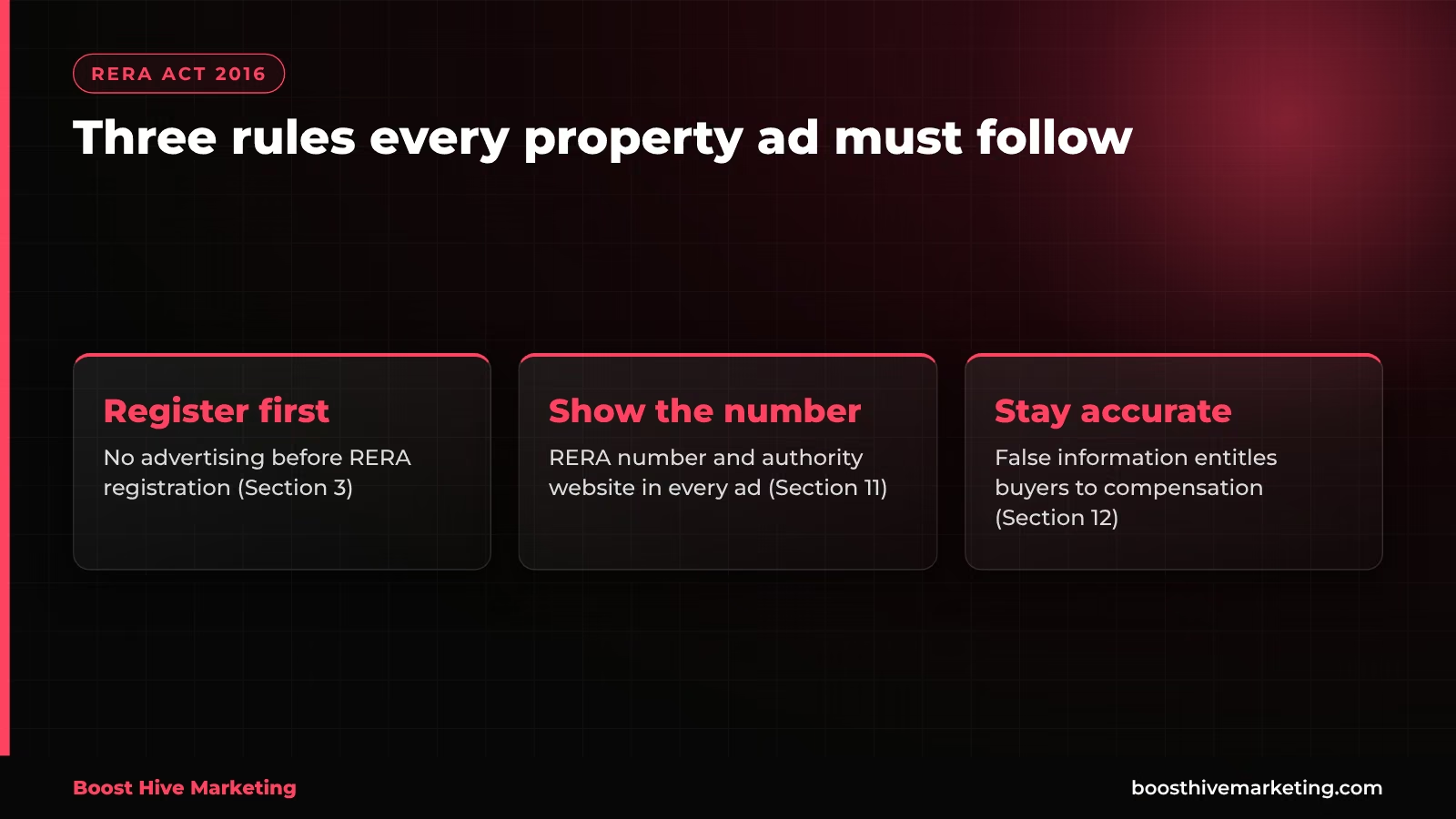
1. No advertising before registration (Section 3)
Section 3(1) says no promoter shall “advertise, market, book, sell or offer for sale, or invite persons to purchase in any manner” a plot, apartment or building in a real estate project “without registering the Real Estate Project with the Real Estate Regulatory Authority”. That covers:
- Pre-launch teasers
- “Coming soon” landing pages that collect leads
- WhatsApp broadcasts
- Expression-of-interest campaigns
If the project isn’t registered, don’t market it.
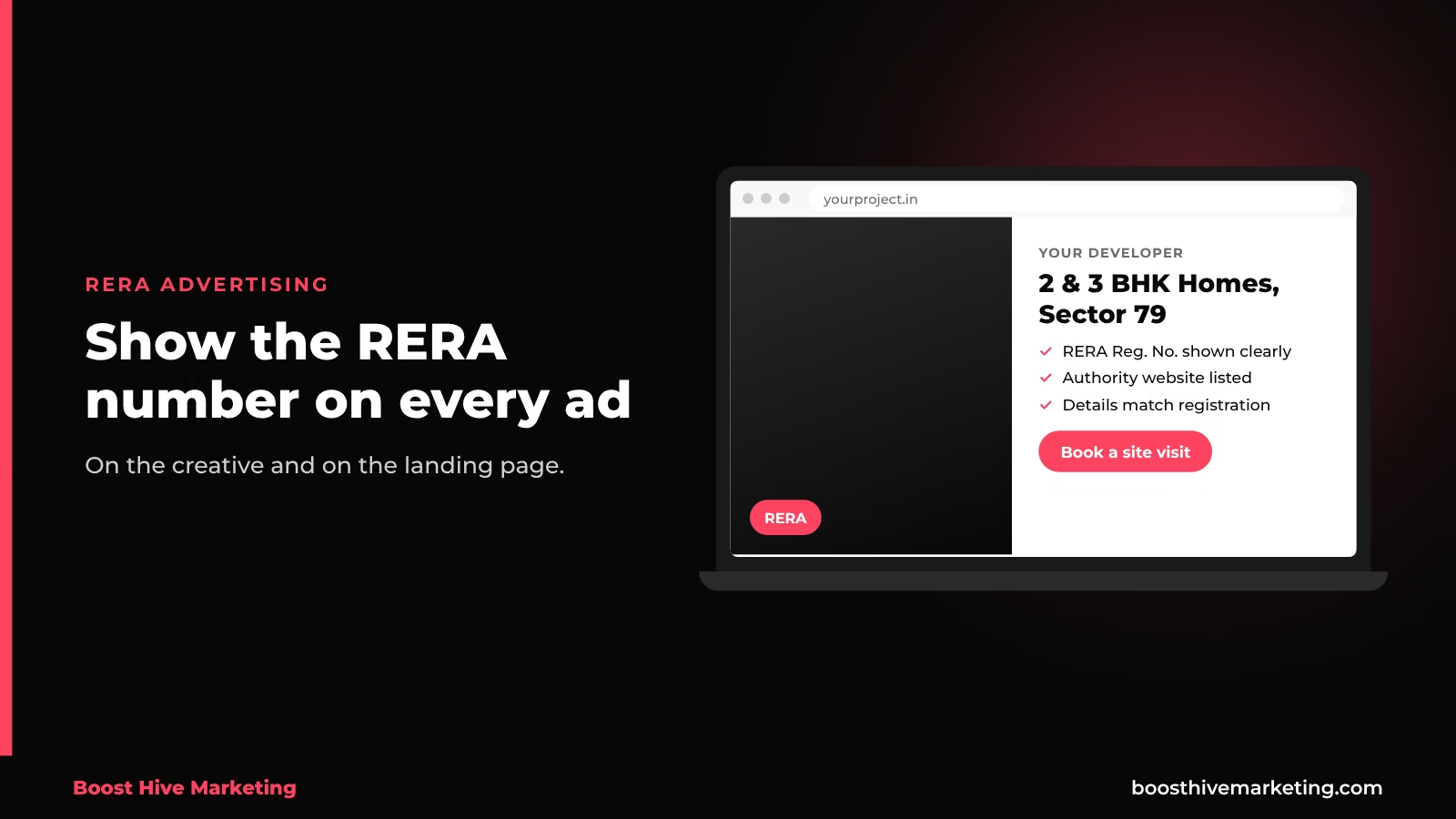
Once registered, the promoter must mention the project’s RERA registration number prominently in advertisements, along with the authority’s website address. The Andhra Pradesh RERA advertisement guidance summarises it plainly: “It is compulsory for the promoter to mention the registration number of the project” on the website and in any advertisement.
3. Don’t advertise anything that isn’t true (Section 12)
If a buyer makes an advance or deposit based on information in an advertisement or prospectus, and that information turns out to be incorrect or false, Section 12 entitles the buyer to compensation. A buyer who wants to withdraw can get their investment back with interest. The AP RERA guidance adds that ads should have “no exaggeration or misinterpretation which may create a biased impression in the minds of the buyers.”
Penalties
| Contravention | Penalty under the Act |
|---|---|
| Advertising or selling without registration (Section 3) | Up to 10% of the estimated cost of the project (Section 59(1)) |
| Continuing to violate Section 3, or not complying with the Authority’s orders | Imprisonment of up to three years, or a further fine of up to 10% of the estimated project cost, or both (Section 59(2)) |
| False information in an ad that a buyer relied on | Compensation to the buyer, or refund with interest if they withdraw (Section 12) |
State authorities also act on smaller lapses. For example, MahaRERA has fined developers over advertisements where the registration details were illegible.
State rules: the MahaRERA QR code example
Each state has its own RERA authority, and some add detailed advertising requirements. The best-known example is Maharashtra. A MahaRERA order dated 29 May 2023 requires promoters to display a QR code prominently on every project advertisement published after 1 August 2023. The QR code must sit beside the MahaRERA registration number and the authority’s website address. The order covers:
- Newspapers and magazines
- Brochures, flyers and leaflets
- Site and sales office standees
- Project websites
- Social media advertisements
The QR code must be legible and readable by software.
If you market projects in more than one state, check each authority’s website for its own advertising rules, formats and any registration-number font or placement requirements.
If you’re a real estate agent or channel partner
Agents must register with the state authority (Section 9) and must not facilitate the sale of a project that isn’t registered (Section 10). In practice, that means:
- Agents running their own ads should show the project’s registration details.
- They should follow state rules on displaying their own agent registration where those apply.
- They should never promote a project before the developer has registered it.
Applying RERA rules to digital campaigns
Google Search and Performance Max
- Put the RERA registration number on the landing page, near the top, and in the footer of every project page.
- Where ad formats allow, include it in image assets or descriptions as well.
- Don’t use claims in headlines that you can’t back with registered project details, such as “guaranteed returns”, unapproved possession dates or “ready to move” before it’s true.
Meta, Instagram and YouTube
- Show the registration number, and in Maharashtra the QR code, legibly on the creative itself, not only in the caption.
- Check that it’s readable on a phone screen. A number in tiny grey text at the edge of a busy image won’t pass.
- Apply the same rules to influencer and channel-partner content about the project.
Lead forms and landing pages
- Don’t collect leads for a project before it’s registered.
- Match every detail on the landing page to the registered project: carpet area, approved amenities and timelines.
- Keep an archive of each ad version and landing page, with dates, so you can show what was published if questions arise.
WhatsApp and SMS
- Broadcasts and brochures sent on WhatsApp are still advertisements.
- Include the registration number and the authority’s website.
- Send only to people who have agreed to hear from you.
RERA advertising checklist
- Is the project registered with the state RERA authority?
- Is the registration number shown prominently and legibly?
- Is the authority’s website address shown?
- Does the state require anything extra, such as MahaRERA’s QR code beside the registration number?
- Does every claim (area, amenities, possession date, approvals) match what’s registered?
- Are there no exaggerated or misleading claims?
- Do agents and channel partners use the same compliant details?
- Is each version of the ad and landing page archived with its date?
Marketing a registered project?
Boost Hive Marketing plans and runs search, social and lead generation campaigns for real estate developers and agents, with RERA details built into every creative and landing page. See our real estate digital marketing services in India, or our city pages for Gurgaon, Hyderabad and Ahmedabad. You may also find boosting real estate leads with PPC advertising useful.
FAQs
Can I run a pre-launch campaign before RERA registration?
No. Section 3(1) prohibits advertising, marketing or inviting people to purchase “in any manner” before the project is registered.
Where should the RERA number appear in a digital ad?
Prominently, on the advertisement itself and on the landing page, together with the authority’s website address. In Maharashtra, a QR code must also sit beside the registration number.
What is the penalty for advertising an unregistered project?
Up to 10% of the estimated project cost under Section 59(1). Continued violation or not following the Authority’s orders can lead to up to three years’ imprisonment, a further fine of up to 10%, or both.
Yes. Section 3 covers advertising or marketing “in any manner”, and MahaRERA’s QR code order explicitly covers websites and social media advertisements.
Do agents need to follow RERA in their ads?
Yes. Agents must register with the state authority and must not facilitate sales of unregistered projects. Their ads should carry the project’s registration details.