
Ask five SEO providers in India for a quote and you may get five very different numbers. One freelancer might quote a few thousand rupees a month. An agency might quote many times that. Both can be honest, because “SEO” covers very different amounts and kinds of work.
This guide explains how SEO is usually priced in India, what the available survey data shows, what actually drives the cost and how to compare quotes so you pay for work that matters.
Prices vary widely, so treat any figure here as context, not a quote.
What the data says about SEO pricing in India
There is very little reliable public data on Indian SEO prices. The most useful source we found is Ahrefs’ SEO pricing survey of 439 SEO service providers worldwide. It was published in December 2023 and updated in August 2024. It reports that:
- 76% of India-based respondents charge US$1,000 or less per month on retainer.
- 85.7% of India-based respondents charge US$30 or less per hour.
- 93.75% of India-based respondents charge US$1,500 or less per project.
- Across all countries, SEOs in India and Central and South America charge the least.
Two cautions apply. The survey is of providers, not buyers, and the number of India-based respondents is small, so read it as a rough indicator. Second, these figures are in US dollars and describe ranges, not a typical price. Use them to sanity-check quotes, not to set a budget on their own.
The three common pricing models
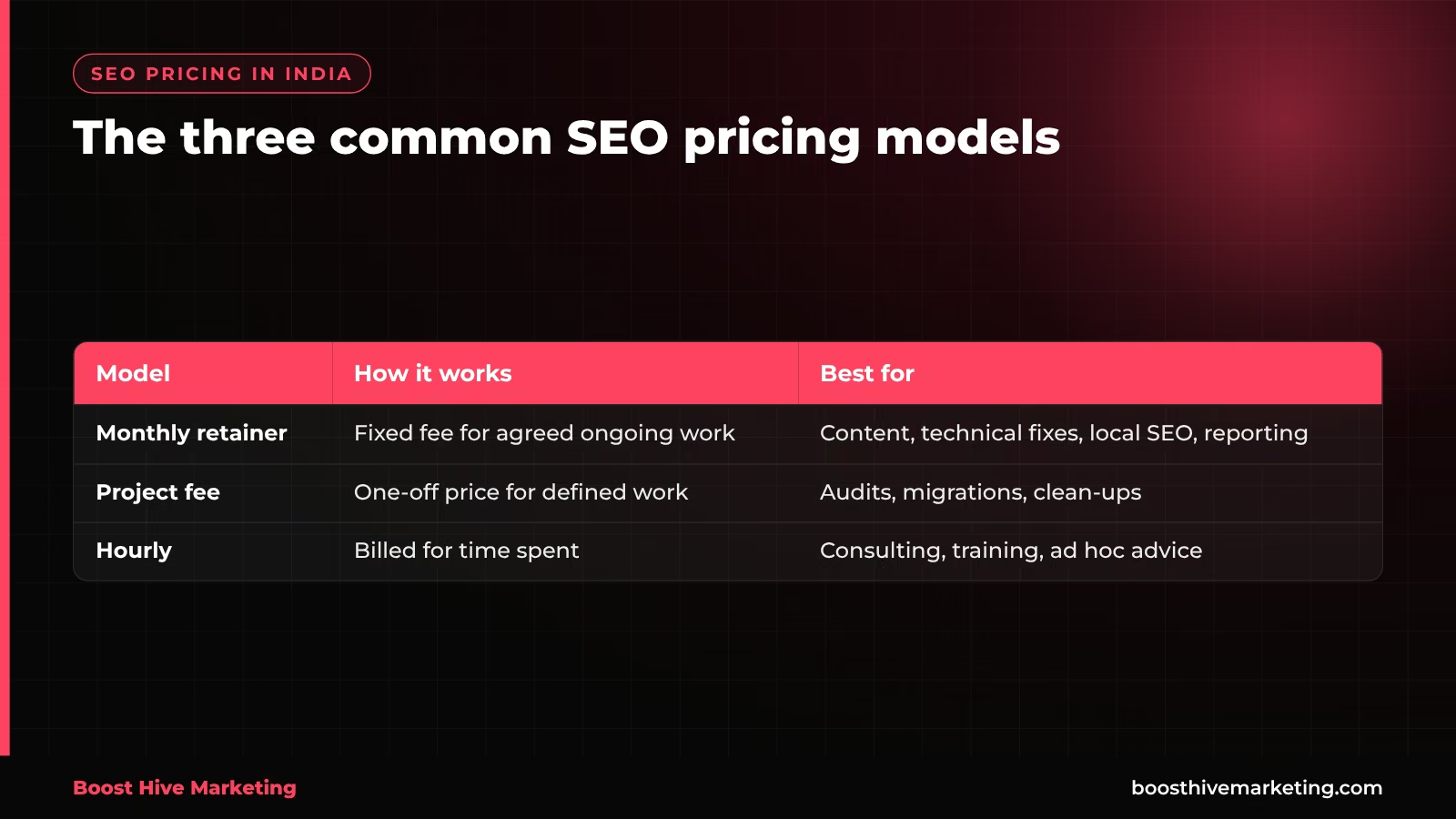
| Model | How it works | Best for | Watch out for |
|---|---|---|---|
| Monthly retainer | A fixed monthly fee for an agreed scope of ongoing work | Businesses that need continuous SEO: content, technical fixes, local SEO and reporting | Vague scopes where you can’t tell what was done each month |
| Project fee | A one-off price for a defined piece of work | Audits, site migrations, technical clean-ups, a set of new pages | Projects that end without anyone owning the follow-up |
| Hourly | Billed for time spent | Consulting, training or ad hoc advice | Open-ended hours without a clear outcome |
The Ahrefs survey found the monthly retainer was the most widely used model, used by 78.2% of respondents. Project pricing was used by 48.9% and hourly by 34.8%. Many providers use more than one.
What actually drives the price
1. How competitive your market is
Ranking a dental clinic in one Gurgaon sector is a different job from ranking a national ecommerce brand for “running shoes”. The more established the sites you’re competing with, the more content, links and time it takes.
2. How many locations and languages you target
A single-city business needs one well-built local presence. A brand targeting several cities, or English plus Hindi or a regional language, needs more pages, more local signals and more ongoing work.
3. The size and state of your website
A 20-page site in good technical shape costs less to work on than a 5,000-product store with crawl issues. A slow, poorly structured site often needs a one-time technical project before ongoing SEO can show results.
4. How much content is included
Content is often the biggest variable. Ask exactly how many pages or articles are included each month, who writes them, how they’re researched and whether they’re edited by someone who knows your industry. Two quotes can look similar until you compare the content.
5. Link building approach
Earning genuine mentions and links from relevant sites takes time and relationships. Be wary of packages that promise a fixed number of backlinks each month for a low price. Google’s spam policies treat links bought to manipulate rankings as link spam.
6. Reporting and access
A good retainer includes clear reporting you can understand. That means Search Console and analytics data, the work completed and what’s planned next. Senior strategy time costs more than execution alone.
What a reasonable SEO scope includes
Whatever the price, you should be able to see what you’re paying for. A sensible ongoing scope usually covers:
- An initial audit: technical issues, content gaps and competitors
- Keyword research mapped to specific pages, so pages don’t compete with each other
- Technical fixes such as speed, indexing, internal linking and structured data
- On-page work: titles, headings, content quality and calls to action
- New content planned around what your customers actually search for
- Local SEO and Google Business Profile work, if you serve local customers
- Monthly reporting tied to business results such as leads, calls and sales, not just rankings
If you’re working with a limited budget, our guide to SEO budget planning for small businesses explains where to spend first.
Red flags in SEO quotes

Google’s own guide, Do you need an SEO?, gives some clear warnings:
- “No one can guarantee a #1 ranking on Google.” If a provider guarantees first place, Google says to find someone else.
- Be wary of anyone claiming a “special relationship” with Google. Google states that it “never accepts money to include or rank sites” in organic results.
Other warning signs:
- A price with no written scope of work
- Large numbers of cheap backlinks promised every month
- No access to your own Search Console, analytics or website accounts
- Reports that show only rankings for keywords nobody searches
- Long lock-in contracts before any results or trust have been established
How to compare SEO quotes in India
- Ask for the scope in writing. List the deliverables per month: number of pages, technical tasks, local SEO work and reports.
- Ask who does the work. A senior strategist, a junior team, or work outsourced to someone else?
- Ask how success is measured. Google suggests asking what results to expect, in what timeframe, and how success is measured.
- Ask for examples. Google also suggests asking for examples of previous work and experience in your industry.
- Check ownership. Content, accounts and data should belong to you.
- Compare cost per deliverable, not just the total. A higher retainer with four researched articles and real technical work can be better value than a cheaper one with generic content.
For a broader checklist, see questions to ask before hiring a digital marketing agency. The questions apply in India too. Our article on why intent-based SEO matters more than rankings explains what good reporting should focus on.
How long before you see results?
SEO is not an overnight channel. Google’s guide doesn’t give a fixed timeframe. It suggests asking your provider what results to expect and when. In practice, technical fixes and improvements to existing pages can show up sooner. New content and authority in a competitive market take longer to build. Budget for several months of consistent work before judging results, and agree in advance what progress should look like at each stage.
Looking for SEO in India?
Boost Hive Marketing provides SEO for businesses across India, with a written scope, clear reporting and no ranking guarantees. See our SEO services in India, or our city pages for Gurgaon, Delhi, Mumbai, Bangalore, Hyderabad and Ahmedabad.
FAQs
How much does SEO cost in India per month?
It varies widely with competition, website size, locations and how much content is included. In Ahrefs’ survey of SEO providers, 76% of India-based respondents said they charge US$1,000 or less per month on retainer. Always compare quotes on scope, not just price.
Is cheap SEO worth it?
It depends on what’s included. Low-cost packages that rely on bulk backlinks or generic content can do more harm than good, because Google treats manipulative links as spam. A smaller, clearly defined scope done properly is usually better value.
Should I pay monthly or per project?
Use a project fee for defined work such as an audit or migration. Use a monthly retainer for ongoing work such as content, technical upkeep and local SEO. Many businesses start with an audit project and then move to a retainer.
Can any SEO agency guarantee first position on Google?
No. Google states that “no one can guarantee a #1 ranking on Google” and advises finding someone else if a provider makes that promise.
Does Google charge for organic rankings?
No. Google says it costs nothing to appear in organic search results and that it never accepts money to include or rank sites there. What you pay an SEO provider is for their work, not for placement.