Running ads in Google Ads often looks simple on the surface. Campaign dashboards show ROAS, conversions, and revenue. Everything appears healthy.
Yet many businesses face a strange situation. Revenue grows, but profit does not move at the same speed.
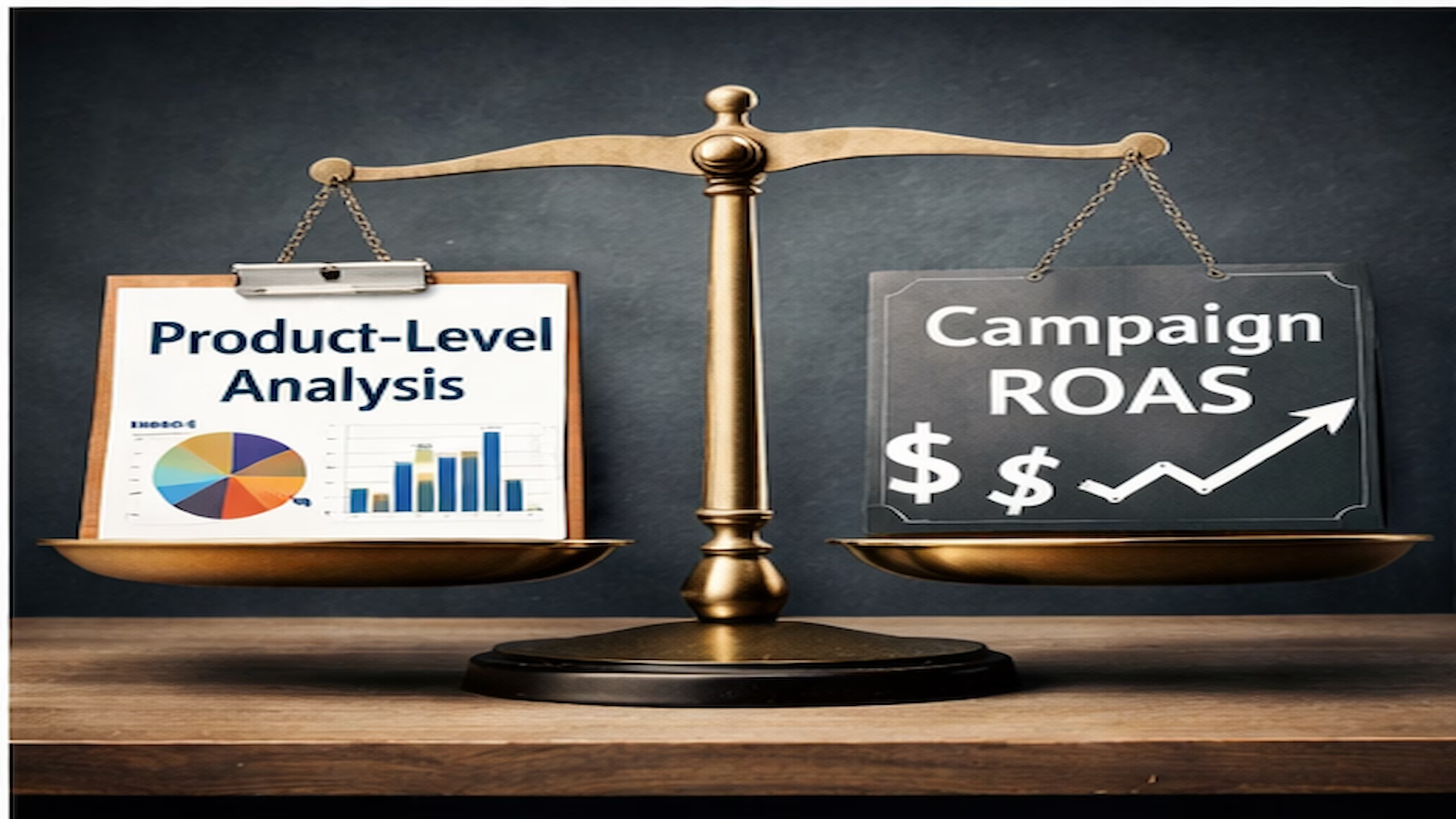
This gap usually happens because marketers analyze campaign performance, not product performance.
A campaign may look profitable. But inside that campaign, some products thrive while others quietly burn the budget.
Smart advertisers focus on Google Ads product-level optimization and profit-based Google Ads optimization. They do not rely only on ROAS reports.
This article explains why product-level analysis matters more than campaign ROAS, how to use a Google Ads budget allocation strategy, and how to scale ads without hurting profitability.
Contents
- 1 The Problem With Campaign-Level Metrics
- 2 Why Product-Level Optimization Changes Everything
- 3 Why Performance Max Campaigns Hide Product Performance
- 4 Why Budget Increases Trigger a Learning Phase in Performance Max
- 5 How to Scale Google Ads Without Increasing CPA
- 6 Signs Your Google Ads Account Needs Product-Level Optimization
- 7 Why Businesses Choose Expert Google Ads Management
- 8 Frequently Asked Questions
- 9 Final Thoughts
The Problem With Campaign-Level Metrics
Many ad accounts follow a familiar structure:
- Brand Campaign
- Search Campaign
- Display Campaign
- Performance Max Campaign
Reports show numbers such as:
- Revenue
- Cost per conversion
- ROAS
These metrics help. However, they hide an important truth.
Campaign metrics average performance across many products. Strong products often carry weaker ones.
As a result, a campaign may show good ROAS while profit margins quietly shrink.
This problem creates confusion in ROAS vs profit in Google Ads discussions.
Businesses believe their campaigns perform well, yet their balance sheet tells a different story.
A better approach focuses on Google Ads product performance analysis.
When marketers analyze product data, they see which products truly deserve ad spend.
That is the foundation of the profit-based Google Ads strategy.
Why Product-Level Optimization Changes Everything
Product-level optimization in Google Ads looks deeper than campaign reports.
Instead of asking “Which campaign performs best?”, experts ask:
Which products generate profitable growth?
This mindset supports Google Ads optimization for profitability not ROAS.
In most ecommerce accounts, a small group of products generates most revenue.
This pattern follows the classic Pareto principle, where roughly 20% of products drive 80% of sales (Harvard Business Review frequently discusses this distribution in business performance analysis).
Therefore, businesses must identify profitable products first.
How to Identify Profitable Products in Google Ads
A strong Google Ads product-level profitability analysis usually includes:
- Product margin evaluation
- Conversion rate comparison
- Customer acquisition cost analysis
- Product demand trends
This approach enables Google Ads product segmentation strategy.
Products then fall into categories:
- High margin and scalable products
- Medium performance products
- Low margin products that should limit ad spend
This segmentation powers Google Ads product-level scaling strategy.
It also supports Google Ads budget allocation by product, a critical step for profitable growth.
Why Performance Max Campaigns Hide Product Performance
Many businesses rely heavily on Performance Max campaign optimization strategy.
Performance Max campaigns use automation to distribute ads across Google properties, including:
- Search
- YouTube
- Display
- Gmail
- Discover
- Shopping
According to Google’s official documentation on automated bidding and campaign automation, the system analyzes large volumes of signals to optimize performance.
This automation offers scale. But it also reduces visibility.
Without Performance Max product segmentation and Performance Max product performance tracking, advertisers struggle to see which products drive results.
This creates challenges for Google Ads product-level optimization.
Why Budget Increases Trigger a Learning Phase in Performance Max
Many advertisers experience sudden instability after scaling budgets.
This happens because of the Performance Max learning phase after budget increase.
Google explains that automated bidding strategies may enter a learning period when significant campaign changes occur. The algorithm recalibrates bids and targeting while collecting new data (Google Ads Help Center).
Budget Increase → Algorithm Re-Learning
When you increase the budget, the system assumes it can enter more auctions.
This triggers AI bidding learning period Google Ads, where the algorithm tests new opportunities.
During this phase, the Performance Max algorithm optimization process recalculates signals.
AI Tests New Auctions and Audiences
The system explores new placements and audiences through Performance Max auction expansion.
This exploration helps the algorithm identify additional conversion opportunities.
CPA Volatility for 7–14 Days
Because the system tests new signals, advertisers often notice fluctuations in:
- CPA
- Conversion rate
- ROAS
This explains why Performance Max CPA increases after scaling.
The instability usually lasts 7–14 days, depending on data volume.
Performance Stabilizes After Data Signals
Once enough data accumulates, the algorithm stabilizes.
This process improves Performance Max product-level optimization and strengthens targeting.
To reduce disruption, experts recommend a Performance Max budget scaling strategy where budgets increase gradually by 10–20%.
This helps stabilize Performance Max campaigns and maintain performance consistency.
Also Read : Why Intent-Based SEO Matters More Than Rankings
How to Scale Google Ads Without Increasing CPA
Scaling campaigns requires careful planning.
Blind budget increases often create rising costs.
A strong Google Ads scaling strategy for profitable products focuses on smart expansion.
Step 1: Identify Profitable Products
Use Google Ads product performance analysis to determine which SKUs drive profitable growth.
Step 2: Allocate Budget Strategically
Implement a Google Ads budget allocation strategy for ecommerce that prioritizes profitable products.
This improves Google Ads profit optimization.
Step 3: Separate Product Groups
Use Google Ads campaign structure best practices to isolate high-performing products.
This improves Google Ads data-driven optimization.
Step 4: Scale Gradually
A controlled Google Ads budget scaling strategy prevents sudden CPA spikes.
This approach helps businesses scale Google Ads campaigns without increasing CPA.
Signs Your Google Ads Account Needs Product-Level Optimization
Your account may need Google Ads product-level optimization if you notice these patterns:
- ROAS looks strong, but profit margins fall
- CPA rises whenever budgets increase
- Performance Max campaigns hide product performance
- A few products generate most conversions
These signals often appear in accounts that rely only on campaign-level metrics.
A deeper Google Ads product-level profitability analysis reveals the true drivers of growth.
Why Businesses Choose Expert Google Ads Management
Many companies partner with experts because Google Ads optimization requires both technical knowledge and business insight.
An experienced Google Ads management agency understands:
- profit-based Google Ads optimization
- performance max campaign optimization strategy
- google ads product segmentation strategy
- google ads budget allocation strategy
Professional teams also focus on improving Google Ads conversion rate, reducing cost per conversion Google Ads, and increasing ROAS Google Ads campaigns.
At Boost Hive Marketing, we focus on data-driven Google Ads optimization and scalable growth strategies.
Our approach prioritizes product-level profitability and sustainable scaling, not just campaign metrics.
Frequently Asked Questions
What is product-level optimization in Google Ads?
Product-level optimization analyzes individual product performance instead of campaign averages. This helps advertisers allocate budget to profitable products and improve overall profitability.
Why does CPA increase after scaling Performance Max budgets?
Budget increases trigger a Google Ads learning phase after budget change. The algorithm tests new auctions and audiences before stabilizing.
How long does the Performance Max learning phase last?
The learning phase usually lasts 7–14 days, depending on conversion volume and campaign changes.
What is the best Google Ads scaling strategy?
The safest Google Ads scaling strategy for profitable products involves gradual budget increases and product-level segmentation.
How can businesses scale Google Ads without increasing CPA?
Focus on product-level analysis, controlled budget increases, and campaign restructuring.
Final Thoughts
Campaign metrics tell only part of the story.
Real growth happens when businesses analyze product performance and profitability.
A strong Google Ads product-level optimization strategy reveals where budgets should go.
When marketers shift from campaign metrics to profit-based Google Ads optimization, advertising becomes a growth engine.
Instead of guessing which campaigns perform well, businesses discover which products truly deserve investment.
That is how smart advertisers scale Google Ads without increasing CPA and build sustainable growth.
If your campaigns look profitable but scaling feels difficult, a deeper product-level analysis may reveal hidden opportunities.
At Boost Hive Marketing, we help businesses transform ad accounts into profit-driven growth systems through professional Google Ads management and data-driven optimization strategies.
Also Read : Why Intent-Based SEO Matters More Than Rankings