
On 6 October 2026, the National Medical Commission (NMC) published new rules on how doctors, clinics and hospitals in India can advertise and communicate with the public. The rules reach well beyond newspaper ads. They cover websites, Google listings, Instagram reels, WhatsApp broadcasts, influencer tie-ups, online healthcare platforms and AI-generated content.
This guide explains what the guidelines say, clause by clause, and what they mean in practice for anyone running a medical practice’s marketing. It covers what is clearly prohibited, what is clearly permitted and where the text leaves room for interpretation.
This article explains marketing practice and is not legal advice. For a ruling on a specific situation, consult your State Medical Council or a healthcare lawyer.
What are the NMC advertising guidelines?
The full title is Guidelines on Ethical Advertising and Public Communication by Hospitals/Medical Institutions and Registered Medical Practitioners. The NMC’s Ethics and Medical Registration Board issued them under reference R-13014/01/2024-Ethics and listed them on the NMC website on 6 October 2026. The public notice states that the guidelines “shall come into force with immediate effect”.
Who they apply to
- Registered medical practitioners (RMPs): every doctor registered with the NMC or a State Medical Council.
- Hospitals and medical institutions: for these, the guidelines are read together with the Clinical Establishments Act or the relevant State Act. Where the two conflict, the Act prevails (Clause 4.3).
- Healthcare platforms that list doctors: they must comply with NMC advertising norms, prohibit paid ranking of doctors and keep listing practices transparent (Clause 9.4).
What counts as advertising
The definition is deliberately wide. Clause 3.2 covers “any form of communication, promotion, publicity, announcement, representation or dissemination of information in any medium”. It names digital, social media, sponsored, targeted, influencer-led, search-engine, platform-based and audio-visual communication. Clause 3.5 lists social media platforms, websites, blogs, online healthcare platforms and “any audio-visual or digital communication by whatsoever name called”.
In practice, a clinic’s website, Google Business Profile, Instagram account, YouTube channel, WhatsApp messages, Google and Meta ads, and listings on doctor-discovery apps all fall within scope.
What the guidelines clearly prohibit
| Practice | What the guidelines say | Clause |
|---|---|---|
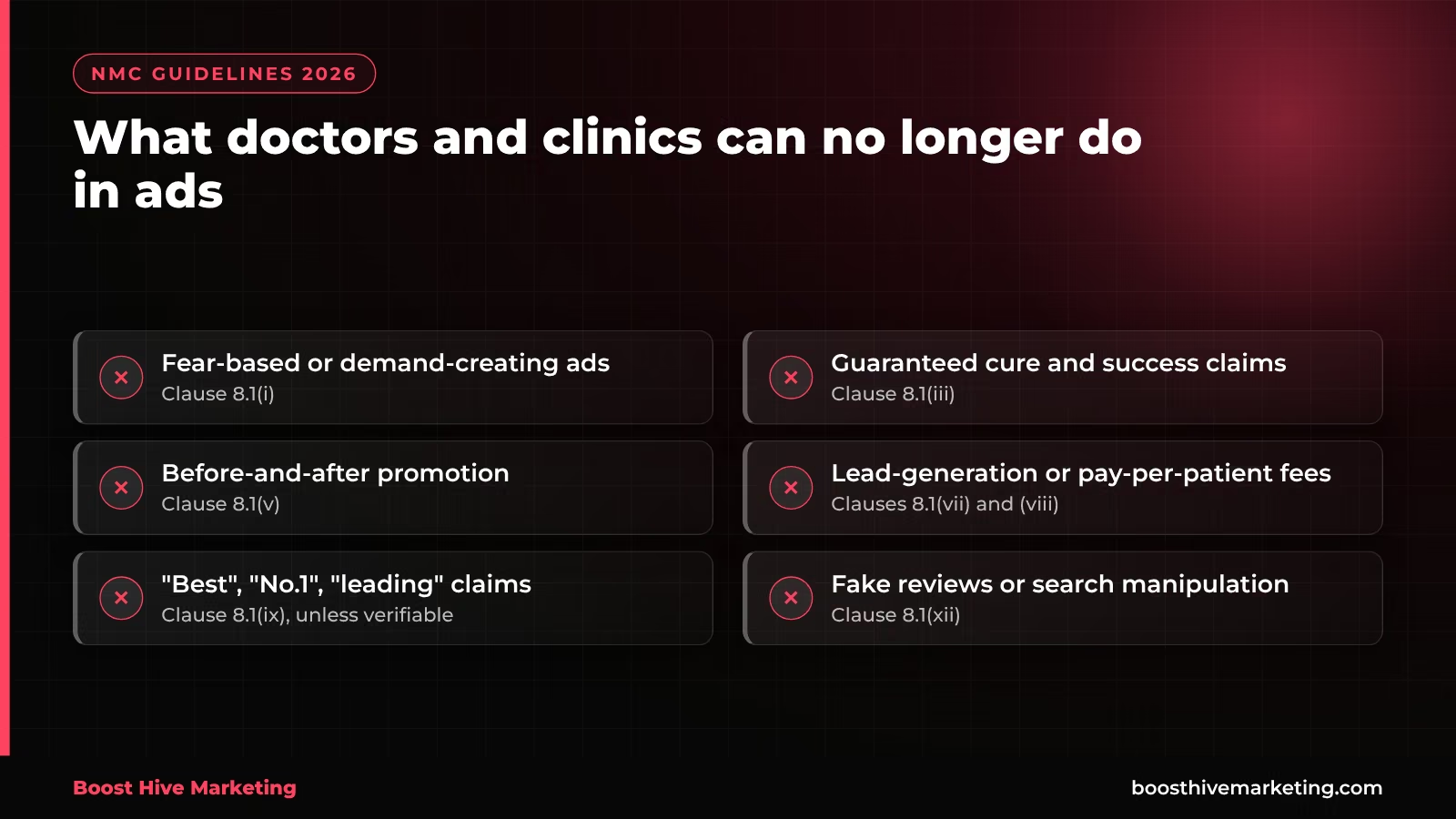
| Fear-based or demand-creating ads | Ads that create unnecessary demand for procedures or diagnostics, or use fear-based marketing | 8.1(i) |
| Solicitation and self-promotion | Soliciting patients directly or indirectly, self-promotion, using third parties to market medical services, or permitting use of the doctor’s name, image, voice or testimonial for promotion | 8.1(ii) |
| Achievement and success claims | Claims about professional achievements, success rates or patient numbers, with examples such as “Guaranteed cures”, “Best doctors”, “No.1 Specialist”, “100% success”, “painless treatment” and “Miracle treatment” | 8.1(iii) |
| Endorsing products | Doctors endorsing drugs or devices using their name, image, voice or professional status | 8.1(iv) |
| Case promotion and before-and-after images | Publishing cases for promotion, advertising surgical results, “before and after” photographs, publicising celebrity patients or personal success stories. Material published strictly for scientific or educational purposes with anonymised, consented patient information is the exception. | 8.1(v) |
| Unrealistic expectations | Statements that create unrealistic expectations, hide risks or promote unproven or secret remedies | 8.1(vi) |
| Commissions and referral fees | Any “commission, rebate, bonus, gift, gratuity, referral fee, lead-generation fee or other consideration” in relation to promotion or advertisement | 8.1(vii) |
| Pay-per-patient arrangements | Engagements with agencies, influencers or online platforms structured so that payment is linked to bringing in or referring individual patients | 8.1(viii) |
| Comparative claims | Claims such as “best”, “No.1”, “leading” and “most trusted”, unless objectively verifiable, based on a transparent methodology and legally permissible | 8.1(ix) |
| Inducements | Discounts, limited-period offers, contests, coupons, gifts, cashbacks, referral benefits and free procedures, where likely to encourage unnecessary care or amounting to solicitation | 8.1(x) |
| Third-party endorsements | Using celebrities, influencers, patients, employees or third parties to promote services through prohibited testimonials or endorsements, including doing indirectly through an intermediary what is prohibited directly | 8.1(xi) |
| Fake engagement and search manipulation | Procuring or manipulating fake followers, likes, reviews, ratings, testimonials, comments or views, or manipulating “search rankings, visibility or algorithms to create a misleading impression of professional standing” | 8.1(xii) |
Two points stand out for marketers. First, Clause 8.1(vii) names “lead-generation fee” explicitly, and Clause 8.1(viii) bars arrangements that tie payment to individual patients. Pay-per-lead and pay-per-patient deals with agencies, platforms or influencers are squarely in scope. Second, Clause 6.2 says patient consent does not, on its own, make a testimonial, endorsement, promotional patient story or before-and-after depiction permissible.
What the guidelines permit
The guidelines are not a ban on communication. They allow factual, verifiable information and specific kinds of announcement.
- Factual institutional information. Clinics and hospitals may share factual, objective and verifiable information such as name, location, contact details, accreditation status, charges and other information permitted by law (Clause 8.3(i)). Clause 9.1 adds facilities offered and applicable fees.
- Doctor directories. A hospital website with a directory of its doctors, giving names, recognised qualifications and similar particulars, “serves a patient-information function” and is regarded as “materially distinct from a paid or promotional advertisement” (Clause 9.1).
- Factual fee disclosure. Any lawful disclosure of charges, packages or fees must be “factual, transparent and not misleading” (Clause 8.1(x)). Public declaration of consultation fees is also listed as permitted (Clause 9.3).
- Formal announcements (Clause 8.2(ii)):
- Starting practice
- A change in type of practice
- A change of address
- Temporary absence from duty
- Resumption of practice or succeeding to another practice
- Public declaration of charges
- Public health education. Lectures or talks on public health and diseases through television, radio and electronic media are permitted. They must be given in the doctor’s own name and designation and must not promote the employer organisation.
- Patient education material. Pamphlets or brochures for patients visiting the clinic are permitted, provided they don’t guarantee cure, claim superiority or include unsubstantiated or misleading claims.
- Research. Research-based communication, such as case studies published in reputed medical journals, is permitted.
- Greetings on days of national importance or days related to the medical profession, without advertising professional gains.
Disclosure rules for digital posts
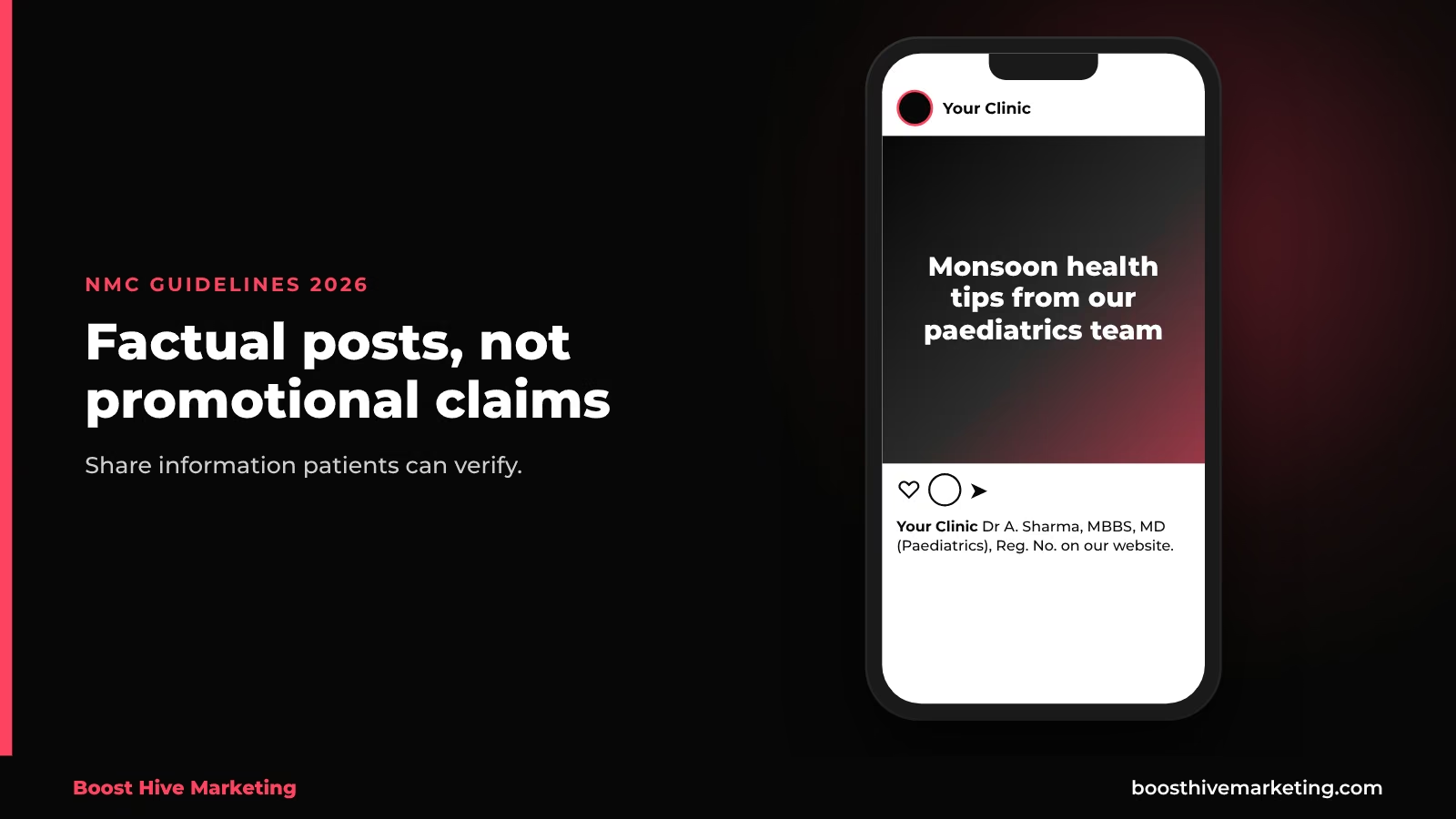
When a doctor publishes an electronic media post, they should disclose their name, qualifications, registration status and SMR/NMR registration number (Clause 3.2, Explanation III). When a clinical establishment publishes one, it should disclose the names of the RMPs involved (Clause 3.2, Explanation IV).
Patient reviews and testimonials
This is the area that needs the most careful reading. The guidelines contain two separate rules.
- Fake, paid or misleading reviews. No RMP or hospital may “solicit, purchase, procure, manipulate or cause to be published” fake, paid or misleading reviews, ratings, testimonials, endorsements or recommendations (Clause 3.2, Explanation V). Clause 8.1(xii) separately bans procuring or manipulating fake reviews and ratings.
- Requesting or sharing reviews for promotion. An RMP “shall not request or share patient testimonials, recommendations, endorsements or reviews” for professional promotion on social media (Clause 3.2, Explanation V).
What this means in practice:
- Clearly prohibited: buying or arranging reviews, writing reviews for the clinic, rewarding patients for reviews, and reposting patient reviews or testimonials as promotional social media content.
- Not restricted: patients posting genuine reviews on their own. The guidelines regulate what doctors and institutions do, not what patients choose to share.
- Not explicitly addressed: asking a patient to leave a genuine review on Google. Google’s own review policy allows businesses to ask for genuine reviews without incentives. The NMC text, however, restricts requesting reviews for professional promotion on social media, and doesn’t say whether a Google review request falls within that. These are two separate sets of rules, and complying with Google’s policy does not by itself mean complying with the NMC’s.
Until the NMC or a State Medical Council clarifies the point, the cautious approach is to avoid organised review campaigns and to let patients review on their own.
Doctor photographs
Clause 9.2 says the use of an RMP’s photograph is not permitted where such use “constitutes self-advertisement, solicitation or promotional publicity.” It also says self-photographs on letterheads and signboards are governed by Regulations 6.1.1 and 6.1.2 of the 2002 IMC Regulations and are regarded as unethical conduct.
The clause doesn’t prohibit every doctor photograph in every context. A plain photo on a doctor directory page, or one used so patients can recognise their doctor, serves a different purpose from a promotional banner, an ad creative or a “meet our top surgeon” post. The test the clause sets is whether the use is self-advertisement, solicitation or promotional publicity.
AI-generated content
The guidelines have a dedicated section on artificial intelligence. Three distinctions matter.
- AI promotional campaigns for commercial interest are prohibited. Clause 7.2 states that an “AI generated promotional campaign for furtherance of commercial interest is prohibited.”
- Other AI-generated promotional content must be labelled. Where AI-generated promotional content is otherwise compliant, it “shall compulsorily carry the source mark, explicitly stating that the origin of the content is AI” (Clause 7.2). Clause 3.2 confirms that AI-generated or AI-assisted promotional communications are treated as advertising, so all the other advertising rules apply.
- Rules for all AI use. Whatever the purpose, AI must not be used to create misleading or unverifiable claims (Clause 7.2(a)). It must never create or manipulate a patient’s image, testimonial, voice or clinical outcome, or produce a synthetic endorsement (Clause 7.2(b)). AI involvement must be disclosed where its artificial nature is material to the audience (Clause 7.2(c)). Patient information used as AI input must meet privacy, confidentiality and data-protection requirements (Clause 7.2(d)).
So there is a real difference between an AI-generated promotional campaign, which is prohibited, and, for example, a patient information page drafted with AI help, checked by a doctor for accuracy and labelled where required. The second is not banned on the face of the text, but it remains subject to the rules above.
Penalties
For practitioners, Clause 10.1 sets out graded action by the State Medical Council:
| Violation | Action |
|---|---|
| First violation | Warning and mandatory ethics training |
| Second violation | Censure and monetary penalty |
| Third violation | Suspension of registration for three to six months |
| Serious violation (for example, misleading cure claims, inducement for patients, digital mass solicitation) | Listed separately as a serious violation |
| Repeated violations | Removal from the medical register for one to three years |
Penalties are imposed only after a show-cause notice (Clause 10.2). Hospitals and medical institutions are dealt with under the applicable Clinical Establishments Act or State Act (Clause 10.1, Explanation; Clause 11.5).
A practical compliance checklist for clinic marketing
Use this to review your existing channels.
Website
- Each doctor page shows name, qualifications, registration status and SMR/NMR registration number.
- No “best”, “No.1”, “leading” or “most trusted” claims unless objectively verifiable, and none of the examples listed in Clause 8.1(iii).
- No before-and-after galleries or promotional patient stories.
- Fees, if shown, are factual and not framed as offers.
- Any award or ranking mentioned can be independently verified.
Google Business Profile and directories
- The profile name matches your real name, with no added keywords.
- No fake listings, extra addresses or arranged reviews.
- No discount offer posts.
- You know whether each directory you’re listed on has stopped paid ranking of doctors, as Clause 9.4 requires.
Social media
- No reposted patient reviews or testimonials.
- No influencer or celebrity promotion of the practice.
- No bought followers, likes or comments.
- Posts that name a doctor carry their registration details.
- AI-generated promotional content, where compliant, carries a source mark.
Ads and agency arrangements
- Ad copy follows the same claim rules as your website.
- No pay-per-lead or pay-per-patient arrangements with agencies, platforms or influencers (Clauses 8.1(vii) and 8.1(viii)).
- No discount, coupon or free-procedure campaigns that could encourage unnecessary care.
What this means for healthcare marketing
The guidelines shift healthcare marketing in India towards information and trust signals that can be checked:
- Accurate listings
- Clear service and doctor pages
- Genuine reviews patients choose to leave
- Educational content that helps patients make decisions
Tactics built on superlatives, testimonials, discounts and volume-based engagement now carry regulatory risk.
For clinics, this means auditing existing channels now rather than waiting for a complaint. For agencies, it means reviewing contracts as well as creatives, because the guidelines reach payment structures too.
If you’d like Boost Hive Marketing to review your clinic’s website, Google profile and social channels against the 2026 rules, see our healthcare digital marketing services in India, or our city pages for Gurgaon, Delhi, Mumbai, Bangalore and Hyderabad.
FAQs
When did the NMC advertising guidelines come into force?
The public notice is dated 6 October 2026 and states that the guidelines came into force with immediate effect.
Do the guidelines apply to hospitals as well as individual doctors?
Yes. For hospitals and medical institutions, they are read together with the Clinical Establishments Act or the relevant State Act, which prevails if there is a conflict (Clause 4.3). Action against institutions is taken under that Act.
The guidelines treat digital, search-engine and social media communication as advertising and apply the same rules. Factual information, permitted announcements and public health education are allowed. Solicitation, superlatives, testimonials, inducements and manipulated engagement are not.
Can a clinic still show its consultation fee?
Yes. Lawful disclosure of fees is allowed if it is factual, transparent and not misleading (Clause 8.1(x)), and public declaration of consultation fees is listed as permitted (Clause 9.3).
Are Google reviews banned for doctors?
No. Fake, paid or misleading reviews are prohibited, and so is requesting or sharing patient reviews for professional promotion on social media. Patients remain free to post genuine reviews on their own.
Can a doctor use AI to create content?
AI-generated promotional campaigns for commercial interest are prohibited. Other compliant AI-generated promotional content must carry a source mark. AI must never be used to create patient images, testimonials or synthetic endorsements (Clause 7.2).
Can we pay a marketing agency per lead or per patient?
Clause 8.1(vii) bars any lead-generation fee or similar consideration in relation to promotion or advertisement. Clause 8.1(viii) bars engagements with agencies, influencers or platforms structured so that payment is linked to bringing in or referring individual patients. Review any such contract with legal advice.