Most brands sit on a pile of content that stopped working the day after it was published. A blog post gets 300 reads in its first week, then nothing. A webinar gets watched live by forty people and never seen again. That is the gap content repurposing closes: taking something you already made and giving it a second, third, and fourth life across different formats and channels.
At Boost Hive Marketing, a content marketing services in Dubai provider working with brands across the UAE, US, Canada, and India, we treat repurposing as a core part of any content plan, not an afterthought. In this guide, we cover what content repurposing actually means, why it matters, and walk through a real workflow you can copy: blog, LinkedIn, reel, email, infographic, and short video, in that order.
What Is Content Repurposing?
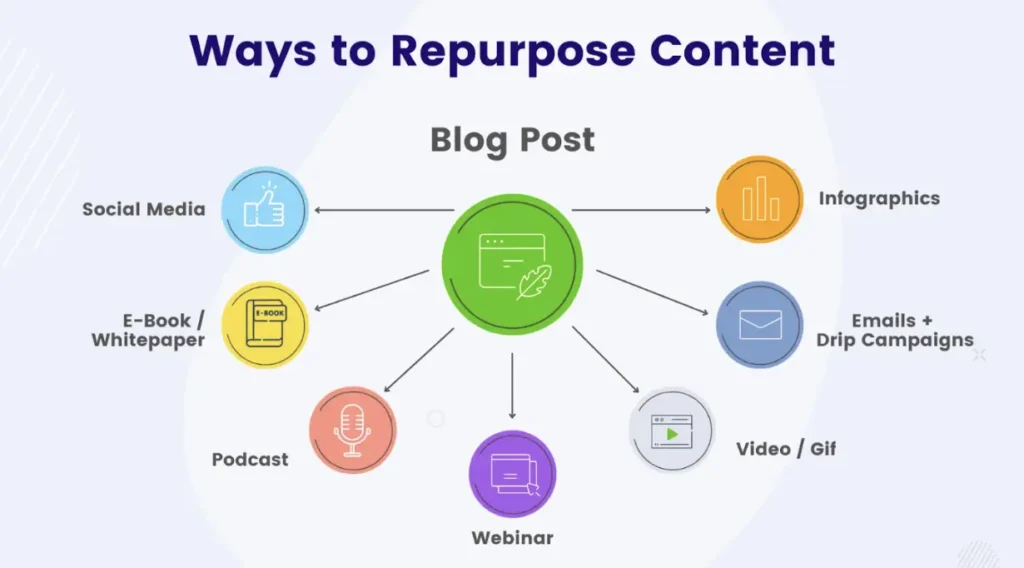
Content repurposing means taking one existing asset (a blog article, webinar recording, podcast episode, or case study) and adapting it into other formats or channels instead of writing something new from zero. A 1,500-word blog post can become a LinkedIn carousel, three Instagram reels, an email newsletter, and a client testimonial graphic, all pulled from research you already did once.
This is different from simply reposting the same thing everywhere. Good content repurposing respects how each platform actually gets used. A LinkedIn audience reads longer captions. A reel audience watches for three seconds before deciding to scroll past. An email subscriber opened your message on purpose, so it can go deeper than either.
Why Content Repurposing Is Essential for Marketing Success
It reaches people who never would have found the original
Not everyone reads blogs. Some people only scroll Instagram, some only check LinkedIn during work hours, some only open email newsletters over coffee. Publishing one format means missing all the audiences who live elsewhere. Repurposing content across formats puts the same core idea in front of each of those groups on the terms they already use.
It stretches your production budget further
Writing, researching, and fact-checking a long article takes real time. Once that work is done, turning it into five smaller pieces costs a fraction of what it took to build the original. For a business with a small in-house team, this is often the difference between publishing consistently and going quiet for weeks between posts.
When one topic shows up as a blog post, a LinkedIn article, and a YouTube short, all pointing back to the same page, it signals depth on that subject to both readers and search engines. Internal links between these pieces also help search engines understand how your content connects, which supports your wider SEO performance over time.
It keeps evergreen content working
A well-researched piece from a year ago can still be accurate and useful today. Instead of letting it sit untouched, content repurposing pulls it back into rotation with a refreshed angle, a new format, or an updated example, so the original research keeps paying off long after publish day.
The Blog to Short Video Workflow
Here is the workflow we run for clients, using one real (anonymised) example: a Dubai-based skincare academy that published a blog on “how to choose a facial treatment for your skin type.”
1. Start with the blog. The blog is the foundation. It holds the full explanation, the data, and any sources. For the skincare academy, this meant a 1,400-word article covering five skin types and which treatments suit each one, with quotes from two of their trainers.
2. Turn it into a LinkedIn post. LinkedIn favours a narrower, more personal angle than the blog. The academy’s founder posted a 200-word story about a student who misdiagnosed her own skin type for years, then linked out to the full blog. It pulled in inquiries from other academies, not just end consumers, which the blog alone hadn’t done.
3. Cut it into a reel. The most visual part of the blog (a side-by-side comparison of how oily versus dry skin reacts under the same treatment) became a 25-second reel. Short-form video works best when it shows something rather than explains it, so the team picked the one segment of the blog that was actually visual.
4. Send it as an email. Existing students got a shorter version through email: three quick tips pulled from the blog, plus a link to book a consultation. Email performs best with a clear, single action, so the academy kept this version tight instead of trying to fit the whole article in.
5. Design an infographic. The five skin types and their matching treatments became a single infographic, easy to save and share on Pinterest and Instagram Stories. Infographics work well for anything with a clear structure or comparison, which this topic already had built in.
6. Build a longer short-form video. Once the reel performed well, the team expanded it into a 90-second YouTube Short featuring one of the trainers walking through all five skin types on camera. This gave them a piece that worked as both a stand-alone video and an embed back on the original blog.
Six formats, one round of original research. That is the actual output of a working content repurposing plan, not a theoretical one.
How Boost Hive Marketing Runs This for Clients
Our process behind every content repurposing project follows four steps:
- Audit – review the existing content library and flag pieces with strong traffic, strong engagement, or evergreen relevance.
- Select and adapt – map out which formats suit each piece (blog to reel, webinar to email series, case study to infographic).
- Optimise and distribute – adjust keywords, captions, and formatting for each channel individually rather than copy-pasting.
- Analyse and refine – track what performed and use that to shape which pieces get repurposed next.
If you already have a backlog of blogs, case studies, or webinar recordings sitting unused, a content marketing services in Dubai partner like Boost Hive Marketing can turn that backlog into weeks of ready-to-publish content instead of starting your calendar from a blank page. Get in touch and we will audit your existing content and map out a repurposing plan built around what you already have.
Frequently Asked Questions (FAQs)
Q1 – What types of content can be repurposed?
Almost any content type: blog posts, videos, webinars, podcasts, white papers, case studies. The key is that the material has enduring value and can be adapted into other formats.
Q2 – How does content repurposing support Content Marketing Dubai efforts?
It enables you to extend the reach and lifespan of your content; diversify format and channel engagement; reinforce SEO; and maximise returns on content investment. Working with a Content Marketing Agency in Dubai like Boost Hive Marketing ensures this strategy is embedded in your campaign planning.
Q3 – Does repurposing mean the content becomes less original?
Not at all. The objective is to re-present or adapt existing content with value enhancement—either by updating, reformatting, or distributing it differently. The original insight remains, but you tailor it for new channels or audiences.
Q4 – How often should content be repurposed?
There is no rigid rule, but the best practice is to prioritise high-performing or evergreen assets and plan repurposing cycles every few months. The strategy is part of ongoing Content Marketing Dubai programming and managed within the frameworks used by a Content Marketing Agency in Dubai.
Q5 – What is the role of a Content Creation Agency in Dubai in this process?
The Content Creation Agency in Dubai develops the initial content assets (blogs, videos, infographics). Once these are live, a partner like Boost Hive Marketing (as your Content Marketing Agency in Dubai and Digital Marketing Agency Dubai) assesses how to repurpose those assets for maximum reach and impact.
Q6 – How do I choose which content to repurpose first?
Begin with content that has: strong historical performance (traffic, engagement); evergreen relevance; or aligns with your brand pillars and audience needs. Then map the best formats and channels for adaptation.
Q7 – What order should the blog-to-video workflow follow?
There is no fixed order, but starting with the blog works well because it holds the full research and sourcing. From there, LinkedIn and email can go out almost immediately, while reels, infographics, and longer video usually need a short design or editing turnaround.
Q8 – Do I need a video team to repurpose a blog into reels or shorts?
Not necessarily. Many reels start as phone footage or simple screen recordings paired with text overlays. A basic editing app and a clear script pulled from the blog’s key point is often enough to test the format before investing in a full production setup.
Q9 – How do I know which part of a blog to turn into a video?
Look for the part of the article that is visual or demonstrable rather than purely explanatory: a comparison, a before-and-after, a step-by-step process. Sections that rely on numbers or lists tend to work better as infographics than video.
Q10 – Can content repurposing work for a business with only a handful of blog posts?
Yes. Even five or six well-researched posts can be broken into weeks of LinkedIn posts, email content, and short videos. Volume of source material matters less than how much usable detail, data, or story each piece already contains.
Also Read – 10 Things to Consider Before Hiring an SEO Agency in Dubai