When someone in Sector 56 searches “dermatologist near me” at 9 pm, Google usually shows a map with three clinics before any website. The same search from DLF Phase 4, Sohna Road or Golf Course Extension Road can show three completely different clinics. For many local health searches in Gurgaon, that map pack is the first thing a patient sees.
Google has published how it decides these local results, and a lot of clinic profiles in Gurugram still miss the basics. The rules for doctors also changed on 6 October 2026, when the National Medical Commission (NMC) issued its Guidelines on Ethical Advertising and Public Communication. Some common Google Maps tactics now carry real regulatory risk.
This guide covers what actually helps a clinic rank higher on Google Maps in Gurgaon, and how to do it within the new NMC rules. Each rule below cites the clause number, so you or your compliance adviser can check the source. Following these steps improves your chances, but nothing can guarantee a particular position on Google Maps.
How Google decides which clinics appear on the map
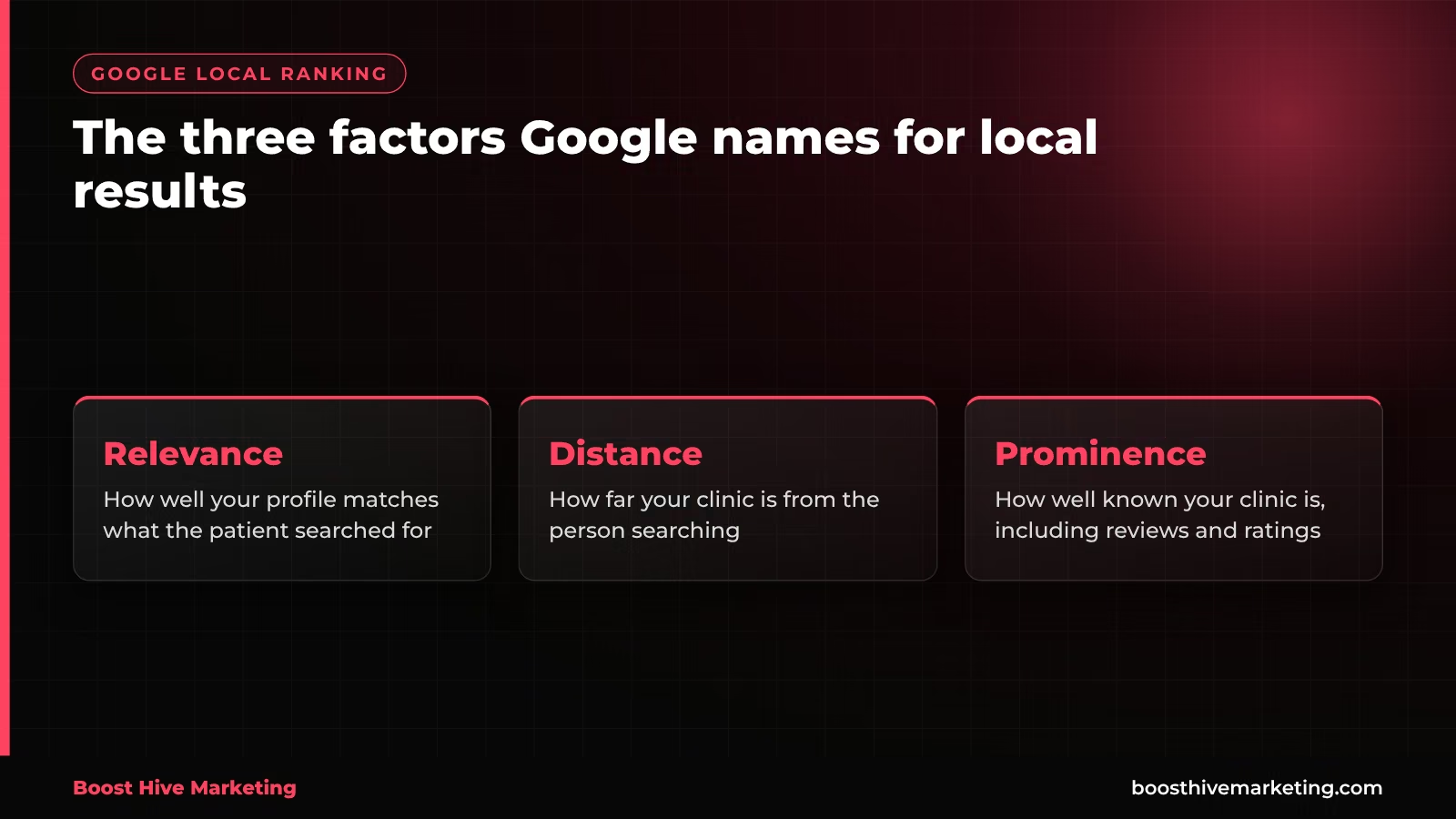
Google’s help page on local ranking names three main factors:
- Relevance: “how well a Business Profile matches what someone is searching for.” A profile that clearly describes a paediatric clinic and lists paediatric services is a closer match for “child specialist near me” than one that just says “clinic”.
- Distance: “how far each business is from the customer who’s searching.” You can’t change this, and it’s why a clinic on Sohna Road rarely appears for a search made in DLF Phase 1.
- Prominence: “how well-known a business is.” Google says that “more reviews and positive ratings can help your business’s local ranking.”
Google also says that “businesses with complete and accurate info are more likely to show up in local search results”. It doesn’t say that filling in every field is a ranking factor by itself. Read it this way: accurate, complete information helps Google match you to the right searches. Missing or wrong information can stop you appearing at all.
Finally, Google is clear that “there’s no way to request or pay for a better local ranking on Google.” Any promise of a guaranteed “No. 1 on Google Maps” result should be treated with suspicion.
Why your Gurgaon neighbourhood matters
Gurugram is large and spread out, and distance plays a big part in local results. In practice, your clinic competes most with the clinics closest to it, not with every clinic in the city. Searches also vary by area:
- Central and older Gurgaon (MG Road, DLF Phases 1 to 5, Sushant Lok, South City, Sector 14 and Sector 56): dense, established neighbourhoods with many clinics close together, so small gaps in your profile matter more.
- Golf Course Road and Golf Course Extension Road: many clinics sit inside commercial towers and malls, so precise addresses and entrance pins are essential.
- Sohna Road and the sectors along it: some patients add the road or sector name to the search (“ENT doctor Sohna Road”). Mentioning your exact location on your website helps you match those searches.
- New Gurgaon (Sectors 80 to 95 along Dwarka Expressway and NH-48): fast-growing residential sectors. Check which clinics currently appear for your speciality there. Where the existing profiles are thin, getting the basics right matters even more.
- DLF CyberCity and Udyog Vihar: a large office workforce nearby, so make your weekday hours and any early-morning or evening slots clear.
The aim is to become the most relevant, best-described clinic within your own radius. Trying to rank across all of Gurgaon from one address rarely works.
What the NMC 2026 guidelines mean for your Google profile
The NMC’s Ethics and Medical Registration Board issued the guidelines on 6 October 2026 (Ref. R-13014/01/2024-Ethics) and published them on the NMC website. The public notice says they came into force with immediate effect. Two points about their scope matter for local search:
- They cover search and platforms. The definition of advertising explicitly includes “search-engine” and “platform-based” communication (Clause 3.2). The media listed include websites, blogs and “online healthcare platforms” (Clause 3.5). Your Business Profile, website and directory listings all fall within that scope.
- They apply to hospitals and clinics too. For hospitals and medical institutions, the guidelines are read together with the Clinical Establishments Act or the relevant State Act. Where the two conflict, the Act prevails (Clause 4.3).
Here’s how the clauses most relevant to a Google profile apply:
| Topic | What the guidelines say | What it means for your profile |
|---|---|---|
| Fake or paid reviews | No RMP or hospital may “solicit, purchase, procure, manipulate or cause to be published” fake, paid or misleading reviews, ratings or testimonials (Clause 3.2, Explanation V). Procuring or manipulating fake “reviews, ratings, testimonials” or other engagement is also prohibited (Clause 8.1(xii)). | Never buy, swap, write or arrange reviews. |
| Requesting and sharing reviews | An RMP “shall not request or share patient testimonials, recommendations, endorsements or reviews” for professional promotion on social media (Clause 3.2, Explanation V). | Don’t repost reviews as promotional posts. Whether asking patients to review you on Google counts is not spelt out, so see Step 5. |
| Search manipulation | No RMP or institution may “manipulate search rankings, visibility or algorithms to create a misleading impression of professional standing” (Clause 8.1(xii)). | No fake listings, fake addresses or keyword-stuffed names. |
| Doctor photographs | An RMP’s photograph is not permitted where its use “constitutes self-advertisement, solicitation or promotional publicity” (Clause 9.2). | A factual photo identifying the doctor is different from a promotional image. Avoid photos used as publicity. |
| Before-and-after images | “Before and after” photographs and advertised surgical results are barred, except material published strictly for scientific or educational purposes with anonymised, consented patient information (Clause 8.1(v)). | Don’t upload before-and-after photos to your profile. |
| Offers and discounts | Discounts, limited-period offers, coupons and similar inducements are barred where they are likely to encourage unnecessary care or amount to solicitation. Any disclosure of fees must be “factual, transparent and not misleading” (Clause 8.1(x)). | Avoid discount “offer” posts. A factual statement of your consultation fee is acceptable. |
| Claims and superlatives | Clause 8.1(iii) bars claims about professional achievements, success rates or patient numbers, and lists examples such as “Guaranteed cures”, “100% success” and “Best doctors”. Clause 8.1(ix) bars comparative claims such as “best”, “No.1”, “leading” and “most trusted” unless they are objectively verifiable, based on a transparent methodology and legally permissible. Any ranking or award used in advertising must be “capable of independent verification”. | Keep your description and posts factual. Don’t use “best” or “No.1” wording, and mention only awards that can be independently verified. |
| AI content | AI-generated or AI-assisted promotional communication is treated as advertising (Clause 3.2). An “AI generated promotional campaign for furtherance of commercial interest” is prohibited, and compliant AI-generated promotional content must carry a source mark (Clause 7.2). AI must not create or manipulate a patient’s image, testimonial, voice or clinical outcome (Clause 7.2(b)). | Never use AI-generated “patient” images or reviews. See the note on AI-assisted information below. |
| Disclosure | In electronic media posts, an RMP should disclose their name, qualifications, registration status and SMR/NMR registration number. Clinical establishments should disclose the names of the RMPs involved (Clause 3.2, Explanations III and IV). | Show these details on doctor pages and in posts that name a doctor. |
A note on AI. The guidelines target AI-generated or AI-assisted promotional communication. On the face of the text, ordinary patient information, such as a clinic page explaining a procedure that was drafted with AI help and checked by a doctor, is not a promotional campaign. It still has to meet the other AI rules. It must not make misleading or unverifiable claims (Clause 7.2(a)). AI involvement must be disclosed where it is material to the reader’s understanding (Clause 7.2(c)). Patient data used in AI tools must follow privacy and confidentiality rules (Clause 7.2(d)).
For practitioners, the guidelines set graded penalties: a warning and mandatory ethics training for a first violation, censure and a monetary penalty for a second, and suspension of registration for three to six months for a third. Serious and repeated violations can lead to removal from the register (Clause 10.1), after a show-cause notice (Clause 10.2). Hospitals and medical institutions are dealt with under the applicable Clinical Establishments Act or State Act.
This article explains marketing practice and is not legal advice. If you’re unsure whether something complies, check with your State Medical Council or a healthcare lawyer.
Step 1: Set up the profile correctly
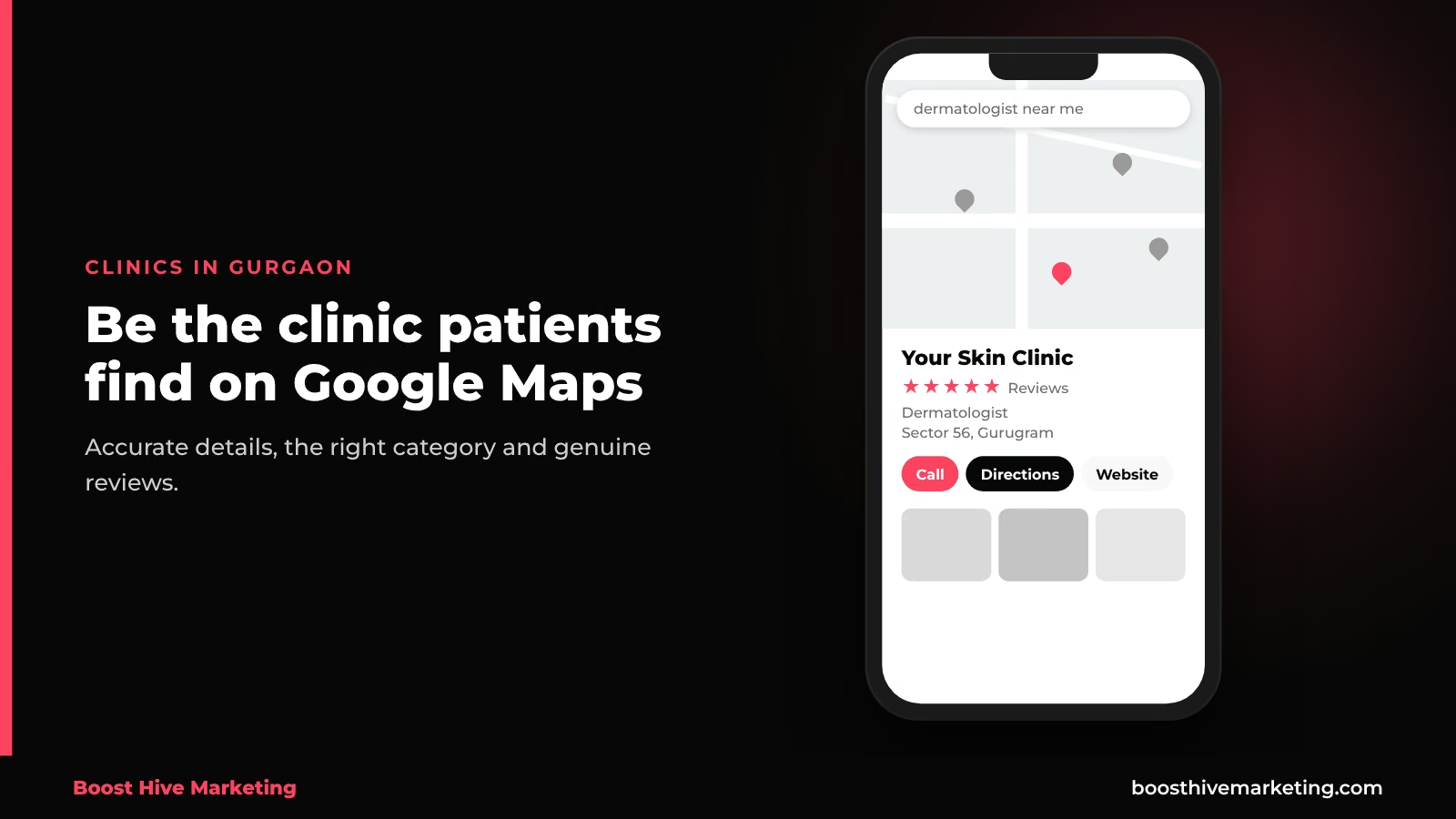
Many local ranking problems start with a profile that was set up incorrectly years ago. Google’s guidelines for representing your business include specific rules for practitioners.
Use your real name
Your profile name should match the name on your signboard, website and letterhead. Adding words like “Best Skin Clinic Gurgaon” breaks Google’s naming guidelines and can lead to suspension. It also conflicts with the NMC’s rules on superlative and comparative claims (Clause 8.1(iii) and 8.1(ix)) and on manipulating search visibility (Clause 8.1(xii)).
Know which practitioner rules apply to you
- Solo doctor at a branded clinic: Google says the profile should be named “[brand/company]: [practitioner name]”, for example “[Clinic name]: Dr [Full name]”.
- Several doctors at one location: the clinic can have its own profile, and each public-facing doctor can have a practitioner profile. That profile is titled with the doctor’s name only, not the clinic’s.
- One profile per practitioner. Don’t create extra profiles for different specialities or for staff who don’t see patients independently.
Fill in accurate details
Add your phone number, website, opening hours, an appointment link if you take online bookings, accessibility details and a plain description of what the clinic treats. Google’s guidance is that complete, accurate information makes you more likely to show up. Set special hours for Diwali, Holi and other closures so patients don’t arrive to a locked door.
For a broader introduction to the profile itself, see our guide to what Google Business Profile is and why it matters. For recent platform changes, see local SEO and Google Business Profile changes in 2026.
Step 2: Get your Gurugram address and map pin right
Google asks businesses to make sure their address is “accurate and precise”. Gurgaon addresses make that harder than it sounds:
- Tower and floor missing. Clinics on Golf Course Road, in DLF CyberCity or inside hospital complexes often share a building with dozens of other businesses. Include the tower, floor and unit.
- Pin in the wrong place. If the automatic pin lands in the middle of a complex or on the main road, Google lets you place it manually. Put it at the entrance patients actually use.
- Gurgaon or Gurugram. The city was officially renamed Gurugram in 2016, but patients still search with both names. Use the address format Google suggests on your profile. Mention both names naturally on your website, for example “our clinic in Sector 56, Gurugram (Gurgaon)”.
- Inconsistent details elsewhere. Keep your clinic name, address and phone number the same on your website, Practo, Justdial and any hospital directory. Consistency means patients find the same, correct information wherever they look.
Never create a profile for an address where you don’t see patients, such as a virtual office or a second address “to cover another sector”. It breaks Google’s guidelines, and it risks being treated as manipulating search visibility under Clause 8.1(xii).
Step 3: Choose categories and services carefully
Google’s guidance is to “choose the fewest number of categories it takes to describe your overall core business” and to make them “as specific as possible, but representative of your main business.” For most clinics, that means a specific primary category such as “Dermatologist”, “Pediatrician” or “Dental clinic” rather than a generic “Medical clinic”. Add secondary categories only for things you genuinely offer.
Then list your treatments in the services section, using the words patients actually search, such as “acne treatment”, “root canal treatment” or “child vaccination”. Keep each description factual: what the service is and who it’s for, with no promises about outcomes.
Step 4: Use photos that inform rather than promote
Google says photos help you “show customers what you offer”. Under the NMC guidelines, the deciding question is whether a photo informs or promotes.
Generally appropriate:
- The building exterior and entrance, so patients can find you
- Reception and waiting area
- Consultation rooms
- Parking and lift access
- Equipment shown factually
- A plain, factual photo that helps patients identify the doctor
Clauses 8.3(i) and 9.1 allow clinics to share factual, verifiable information, such as name, location, contact details and facilities. Clause 9.2 restricts doctor photographs where their use is self-advertisement, solicitation or promotional publicity, not in every case.
Avoid:
- Before-and-after images (Clause 8.1(v))
- Patient photos used for promotion
- Doctor photos used as publicity, such as “meet our top surgeon” banners or images overlaid with promotional slogans
- Award graphics you can’t independently verify
- AI-generated images of patients or results (Clause 7.2(b))
Clause 9.2 also says self-photographs on letterheads and signboards are governed by the 2002 IMC Regulations and are regarded as unethical conduct.
Step 5: Handle reviews within Google and NMC rules
Reviews are where clinics most need to separate what’s clearly prohibited from what’s uncertain.
Clearly prohibited
- Buying, swapping, writing or arranging fake, paid or misleading reviews (Clause 3.2, Explanation V; Clause 8.1(xii))
- Offering anything in return for a review. This breaks Google’s review policy and could also fall under the NMC’s restrictions on inducements (Clause 8.1(x)).
- Sharing patient reviews or testimonials as promotional posts on social media (Clause 3.2, Explanation V)
- Using patients, employees or third parties to promote the clinic through testimonials (Clause 8.1(xi))
Not restricted
Patients posting genuine reviews on their own. The guidelines regulate what doctors and institutions do. Nothing in them stops a patient from sharing an honest experience on Google.
Uncertain: asking patients to leave a Google review
Google’s policy lets businesses ask customers for genuine reviews, provided they don’t offer incentives or ask only happy customers. The NMC text says an RMP shall not “request or share” patient reviews for professional promotion on social media. It doesn’t say whether a Google review request counts as promotion on social media. Until the NMC or your State Medical Council clarifies this, the cautious approach is:
- Don’t run organised review campaigns, such as bulk messages, review targets for staff or “leave us 5 stars” standees.
- Make your profile easy to find, so patients who want to leave a review can do it on their own.
- If you want to do more, get written guidance from your State Medical Council or a healthcare lawyer first.
Responding to reviews
Google notes that replying “shows that you value their feedback.” Reply briefly and calmly. Never confirm that someone was a patient or mention their condition or treatment, even if they did. Invite anyone unhappy to contact the clinic directly. Report reviews that break Google’s policy, such as spam or reviews from people who were never patients, instead of arguing publicly.
Step 6: Connect the profile to a strong website
Your Business Profile links to your website, and the two should tell the same story. A thin one-page site gives patients little reason to choose you. A clear site helps patients and gives search engines more to understand:
- A page for each main service covering what it is, who it suits, what to expect and, if you choose, the consultation fee stated factually
- A page for each doctor with name, recognised qualifications, speciality, registration status and SMR/NMR registration number. Clause 9.1 says a hospital directory of doctors with this kind of information serves a patient-information function and is “materially distinct from a paid or promotional advertisement”.
- Location details: your full address with tower and floor, a map embed, directions from the nearest Rapid Metro station or a well-known landmark, and parking information
- Fast, mobile-friendly pages, because many patients search for clinics on their phones
- A tracked link: add UTM parameters to the website link on your profile so map-driven visits show up separately in Google Analytics
For the wider SEO picture beyond Maps, see how to rank a healthcare practice on Google.
Step 7: Build local visibility the right way
Google describes prominence as how well-known a business is, and says reviews and ratings play a part. Many local SEO practitioners also treat genuine mentions and links from trusted local websites as part of prominence. Google doesn’t publish how much any of this counts.
The NMC guidelines narrow the options. Clause 8.1(vii) bars any “commission, rebate, bonus, gift, gratuity, referral fee, lead-generation fee or other consideration” in relation to promotion or advertisement. Clause 8.1(viii) says arrangements must not link payment to bringing in or referring individual patients. Legitimate options include:
- Accurate directory listings on the healthcare platforms and local directories patients already use, with details that match your profile. Clause 9.4 requires healthcare platforms to prohibit paid ranking of doctors and to keep listing practices transparent.
- Hospital affiliations: if you consult at a hospital in Gurgaon, check that its doctor directory lists you correctly.
- Formal announcements are expressly permitted (Clause 8.2(ii)). They cover starting a practice, a change of address or type of practice, temporary absence and resumption, and a public declaration of charges.
- Public health awareness: talks on public health for TV, radio and electronic media are a permitted category. They must be given in the doctor’s own name and designation and must not promote the employer. In-person awareness sessions, such as an RWA health talk in Sushant Lok or a wellness session in Udyog Vihar, are not listed as an exception. Keep them strictly educational and check with your Council if in doubt.
If you run clinics in more than one area of Delhi NCR, you can also read how we approach healthcare marketing in Delhi and Faridabad.
How to measure progress
Your Business Profile’s performance report shows calls, direction requests, website clicks and the searches people used to find you. Review it monthly, because local results vary by searcher and location. Track:
- Calls and direction requests, the clearest sign that Google Maps is bringing you patients
- Searches for your speciality rather than your clinic’s name, which shows whether you’re reaching new patients
- Map-driven website visits, using the UTM-tagged link in Google Analytics
Expect gradual change. Fixing a wrong category, a misplaced pin or a duplicate profile can help fairly quickly. Building prominence takes months.
Common mistakes to avoid
- Adding keywords or “best” to the profile name
- Duplicate profiles for each speciality, or profiles for addresses where you don’t practise
- Leaving an old profile from a previous address live instead of marking it as moved or closed
- Organised review drives, or anything offered in return for reviews
- Discount offers or before-and-after photos
- Letting a staff member’s personal email own the profile. Keep ownership with the clinic and add others as managers.
- Ignoring edits suggested by users and photos uploaded by the public. Check the profile weekly.
Need help with your clinic’s local visibility?
Boost Hive Marketing helps clinics and healthcare providers with local SEO, Google Business Profile management and websites, built around the 2026 NMC guidelines. See how we approach healthcare digital marketing in Gurgaon, our local SEO services in Gurgaon and our wider SEO services in Gurgaon. If you have clinics across India, see our healthcare digital marketing services in India.
FAQs
How long does it take for a clinic to rank on Google Maps in Gurgaon?
Fixing basic problems, such as the wrong category, an inaccurate address or pin, or duplicate profiles, can help within weeks. Building prominence takes months. Distance always plays a part, so a clinic in Sector 56 will find it easier to rank for nearby searches than for searches in New Gurgaon.
Can I pay Google to rank my clinic higher on Maps?
No. Google states that “there’s no way to request or pay for a better local ranking.” Google Ads can show a labelled sponsored listing, but that is advertising. The NMC’s definition of advertising includes search-engine promotion (Clause 3.2), so the same content rules apply to ads.
Are doctors in India allowed to ask patients for Google reviews?
The NMC guidelines clearly prohibit fake, paid, misleading or manipulated reviews. They also prohibit requesting or sharing patient reviews for professional promotion on social media. They don’t explicitly address asking a patient to leave a genuine Google review. Until that’s clarified, the cautious approach is to avoid organised review campaigns and let patients review on their own.
Can a patient post a review of my clinic on their own?
Yes. The guidelines regulate the conduct of doctors and institutions, not patients sharing their own genuine experience.
Can I show a photo of the doctor on my Google profile?
Clause 9.2 restricts an RMP’s photograph where its use is self-advertisement, solicitation or promotional publicity. A plain, factual photo that helps patients recognise the doctor is different from a promotional image. Avoid slogans, award graphics or “top doctor” styling.
Should my profile say Gurgaon or Gurugram?
Use the address format Google suggests for your location. On your website, mention both names naturally, because patients still search for both.
Can I use AI to write content for my clinic?
AI-generated promotional campaigns for commercial interest are prohibited. Compliant AI-generated promotional content must carry a source mark (Clause 7.2). On the face of the text, AI-assisted patient information that a doctor has checked for accuracy is not a promotional campaign, but it must not be misleading (Clause 7.2(a)). AI must never be used to create patient images or testimonials.