A salon owner in Leeds checked her booking software one Monday morning and found three empty columns for the week ahead, despite her Instagram following creeping past ten thousand. Meanwhile, a much smaller salon two streets over was fully booked three weeks out, with barely half the followers but a website that ranked on the first page for “hair salon near me” and a booking link that actually worked from every platform. Followers don’t fill chairs. A proper system does.
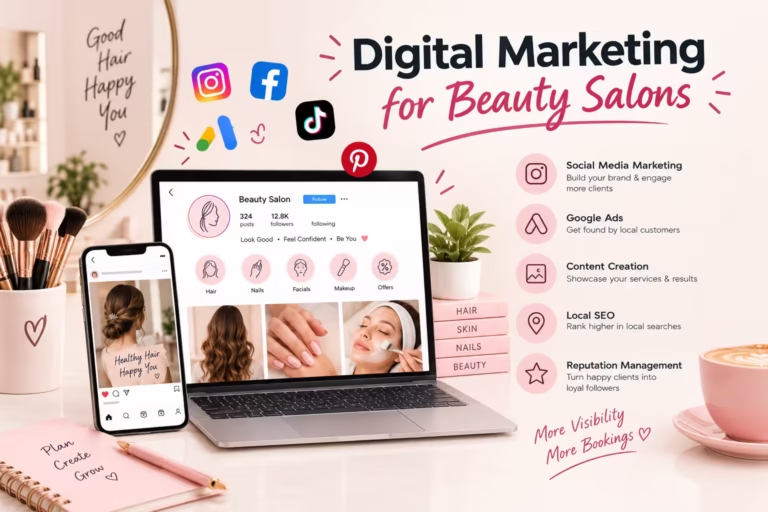
That’s the real story behind digital marketing for beauty salons in the UK right now. It isn’t about picking one channel and hoping it carries the whole business. It’s about connecting search visibility, social content, booking software, and client retention into something that works together, day after day, rather than relying on word-of-mouth and the occasional boosted post.
Why a Scattered Approach Stops Working
Most salons already do a version of digital marketing. They post on Instagram, maybe run the odd promotion, and have a website somewhere. The problem is that these pieces rarely talk to each other. A stunning Reel with no working booking link loses the client the moment they’re ready to act. A ranking website that isn’t linked properly from social profiles wastes the traffic it worked hard to earn.
When someone searches “hair salon near me” or a specific treatment plus their town, the top three results on Google Maps capture the overwhelming majority of clicks and calls. Everything below that gets scraps. This is the reality digital marketing for beauty salons needs to be built around: visibility isn’t optional, it’s the entire game.
The Website Is Still the Foundation
Instagram drives discovery and brand personality, but the website is what actually converts a browsing visitor into a paying client. It needs to load fast, particularly on mobile, since a two-second delay in load time can increase bounce rates by around 32%. Beyond speed, a salon website needs clear treatment pages with pricing, genuine photography, and a booking link that stays visible no matter how far someone scrolls.
Choosing the right booking platform matters more than most salons realise. Options like Fresha, Booksy, and Timely each come with different pricing structures, some charging a flat monthly fee, others taking a commission on new client bookings through their marketplace. Getting this wrong doesn’t just cost money, it can quietly undermine the SEO and marketing effort sitting around it if the booking process itself is clunky or unreliable.
Local SEO Does the Heavy Lifting
Local search is where the majority of new client discovery happens, and it deserves more attention than most salons give it.
- Google Business Profile needs full completion: accurate services, current opening hours, and regular photo updates, since this often appears before the website itself in search results.
- Location-specific landing pages matter for salons with multiple branches, since a single combined page rarely ranks well for more than one area at once.
- Local citations and consistent business details across the web build the kind of authority Google associates with trusted local businesses.
Salons that treat local SEO as a background task rather than an active strategy tend to lose visibility to competitors updating their listings regularly, even when the actual service quality is identical.
Read Also: Local SEO for Beauty Academies
Social Media Still Has Its Place, Just Not Alone
Instagram and TikTok remain genuinely useful for digital marketing for beauty salons, particularly for showcasing transformations and building trust before a first booking. The mistake most salons make is treating social media as the entire strategy rather than one piece of it. Video content now drives the overwhelming majority of consumer engagement online, so static, occasional posts simply don’t carry the same weight they once did.
The stronger approach treats Instagram and TikTok as discovery tools that feed traffic toward the website, where the actual conversion happens through a working booking system.
For a broader beauty-industry approach, see our Marketing for Beauty Industry guide.
Paid Advertising for Faster Results
Organic growth through SEO and content takes time to compound, often four to eight weeks before meaningful movement. Paid advertising through Google Ads and Meta tends to generate new client bookings much faster, sometimes within the first week of a campaign going live. This makes paid ads particularly useful for filling gaps quickly, such as promoting a new treatment or covering a quiet period, while the slower organic strategy builds in the background.
| Channel | Typical Timeframe to Results |
|---|---|
| Google Ads / Meta Ads | Within the first week |
| Social media engagement growth | Two to three weeks |
| Local SEO | Four to eight weeks, compounding |
Automation and CRM Tools Quietly Save Bookings
A missed call or an unanswered enquiry is a lost booking, and this is where automation tools have become genuinely useful rather than gimmicky. Automated follow-up messages, birthday promotions, and re-engagement campaigns for clients who haven’t booked in a while all help retain existing clients without constant manual effort. Some salons now use AI-driven communication tools to capture out-of-hours enquiries that would otherwise go unanswered until the next working day, recovering bookings that used to simply disappear.
Reputation Management Isn’t Optional Anymore
Reviews influence both search rankings and a new client’s decision to book. A salon with a handful of outdated reviews looks less trustworthy than a competitor with a steady stream of recent, detailed feedback, even if the actual treatments are comparable in quality. Encouraging reviews shortly after a visit, while the experience is fresh, tends to produce better results than hoping clients remember to leave one weeks later.
Bringing It All Together
None of these pieces work particularly well in isolation. A ranking website with no booking integration loses clients at the final step. A strong social presence with a weak local SEO foundation misses the majority of people searching directly on Google. Effective digital marketing for beauty salons connects the website, local search, social content, paid ads, and follow-up automation into one system, rather than treating each as a separate task handled whenever there’s spare time.
Salons that build this properly stop relying on chance and start seeing a predictable, repeatable flow of new bookings, month after month, regardless of what’s trending on social media that particular week.
Ready to turn your salon’s online presence into a genuine booking engine? Get in touch with Boost Hive Marketing for a strategy built around your treatments, location, and client goals.
FAQs
1. What does digital marketing for beauty salons actually include?
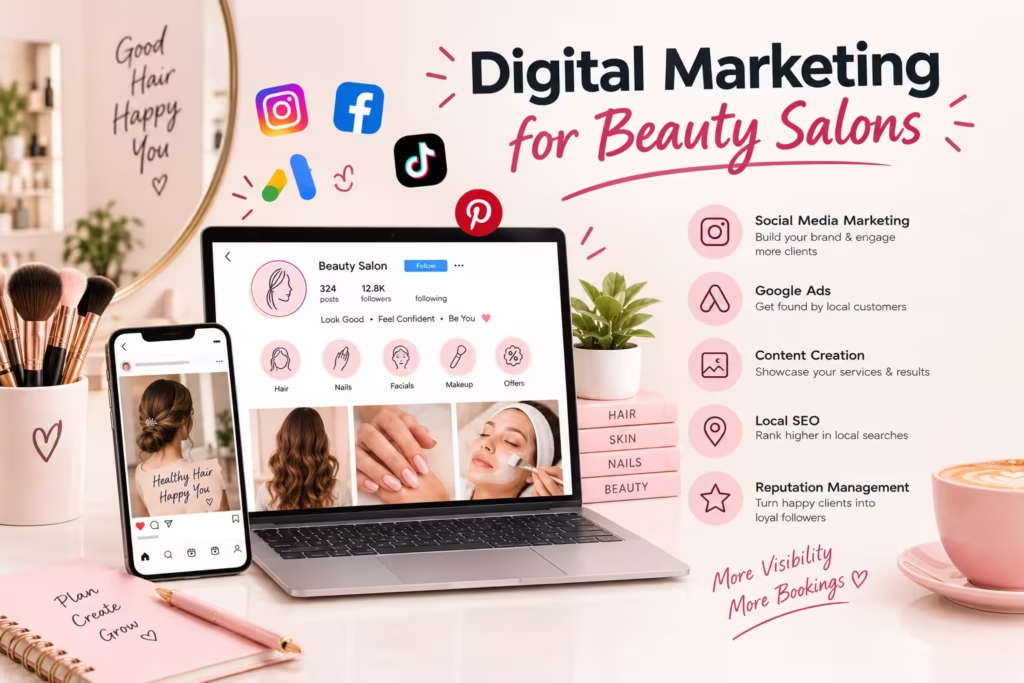
It typically covers website design, local SEO, social media, paid advertising, email or SMS follow-ups, and reputation management, all working together rather than as separate efforts.
2. How much does digital marketing cost for a UK beauty salon?
Costs vary widely depending on scope, but comprehensive packages covering website, SEO, ads, and automation often start from several hundred pounds a month.
3. How quickly can a salon expect to see new bookings from digital marketing?
Paid ads can generate bookings within the first week, while local SEO typically takes four to eight weeks to show meaningful, compounding results.
4. Is Instagram enough on its own to grow a beauty salon?
No. Instagram builds awareness and trust, but it needs to be paired with a strong website and booking system to actually convert that attention into appointments.
5. Which booking software is best for a UK salon?
Options like Fresha, Booksy, and Timely each suit different needs, so comparing commission structures and features against the salon’s size matters more than picking the most popular name.
6. Does local SEO really matter for a single-location salon?
Yes, significantly. Most new clients discover salons through local search, and the top few results on Google Maps capture the majority of enquiries.
7. Should salons run paid ads and organic marketing at the same time?
Yes, this combination tends to work best, with paid ads filling gaps quickly while local SEO and content build longer-term, sustainable visibility.
8. How important are online reviews to a salon’s digital marketing?
Very important. Reviews influence both search rankings and a new client’s willingness to book, particularly when comparing similar local salons.
9. What’s the biggest mistake salons make with digital marketing?
Treating individual channels like social media or a website as standalone efforts rather than connecting them into one coordinated system.
10. Can automation tools genuinely help a small, independent salon?
Yes, automated follow-ups and missed-call recovery tools help retain bookings that would otherwise be lost outside normal working hours, even for a single-location salon.