Google’s May 2026 core update rolled out from May 21 to June 2, making it the second broad core update of the year after March 2026. It ran about 12 days, roughly in line with the “up to two weeks” window Google quoted at launch, and by most accounts it hit harder and moved less predictably than the update before it.
Here’s what actually happened, what the data shows about who lost and gained, and what to do if your traffic dropped.
Timeline: How the Update Rolled Out
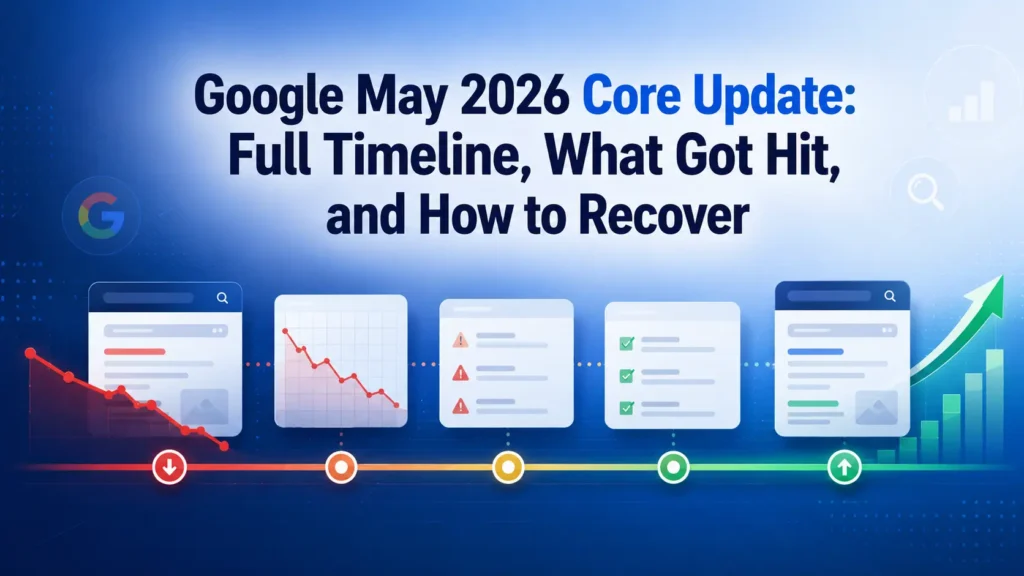
Google confirmed the update on May 21, 2026, at 8:40 AM Pacific through its Search Status Dashboard. The wording was the same boilerplate Google uses for every core update: “a regular update designed to better surface relevant, satisfying content for searchers from all types of sites.” Completion followed on June 2, at 5:40 AM Pacific.
One detail stood out. Google Search Central posted the announcement on LinkedIn before the Search Status Dashboard logged it, a reversal of the usual pattern where X gets the news first. It’s a minor shift, but it signals that Google now treats the SEO and marketing crowd on LinkedIn as a direct audience worth reaching, not just a group that reposts news after the fact.
The rollout itself wasn’t smooth. Tracking tools recorded three distinct volatility spikes: the weekend of May 23, a sharp jump on May 30, and a final burst on June 2, the same day Google marked the update complete. Reading your Search Console data mid-rollout, or even the day the update finished, tends to give a misleading picture. Google recommends waiting roughly a week after completion, meaning the earliest reliable comparison window opened around June 9.
What Got Hit Hardest
Gambling sites reported some of the sharpest swings of any category. YMYL content, meaning pages touching health, finance, or anything where inaccurate advice has real consequences, also saw significant movement, alongside thin commerce pages built on templated or aggregated product listings.
Across several tracked niches, a large share of top-ranking results shifted toward branded, official sources and away from aggregators and syndicated content. That fits the pattern core updates have followed since the original Helpful Content updates: rewarding pages that come from an actual source, not just pages that summarize what other sources already said.
Google’s own framing hasn’t changed either. Its standing guidance is that sites don’t need to do anything special beyond making content that’s genuinely useful to the person reading it, not content built to satisfy a search algorithm.
Why This Update Carries More Weight Than Past Ones
The stakes around ranking position have changed. At Google I/O, held two days before this update began, Google said AI Overviews now reaches 2.5 billion monthly users, and AI Mode passed a billion. When an AI-generated summary sits above the organic results, click-through concentrates even harder near the top.
That changes what a ranking drop actually costs. Falling from first to fourth used to mean losing some traffic. Now, with AI Overviews absorbing more of the searcher’s attention before they ever scroll, it can mean losing most of it. The practical takeaway: recovering or defending your highest-traffic, highest-intent pages matters more than it used to, because the value gap between position one and position four keeps growing.
How to Diagnose and Recover
Start by isolating which pages actually lost traffic. Compare Search Console data from the week before May 21 against a clean window from mid-June onward, and flag anything that dropped meaningfully rather than reacting to daily noise.
From there, look at what those pages have in common. A few patterns worth checking:
Does the page answer the query fast, or make the reader work for it?
Content that buries the answer under a long intro tends to underperform, both for human readers and for AI Overviews scanning for something extractable.
Pages with no named author, no credentials, and no way to verify who wrote them are working against themselves in a search environment that increasingly rewards demonstrable expertise and trust.
Is the content actually current, or just re-dated?
A page from 2022 with a 2026 timestamp and no substantive changes isn’t fooling anyone. Genuine updates, new examples, current data, and removed outdated sections tend to hold up better across core updates than a superficial refresh.
Fix your highest-value pages first. Google has been clear that recovery isn’t guaranteed on any fixed timeline, and that the biggest shifts often show up around the next core update rather than right after changes go live. Deleting content wholesale is rarely the right first move; diagnosing by page type and fixing the weakest elements usually is. Google has now run six or more broad core updates since March 2024, and the pace shows no sign of slowing as AI-driven search reshapes what ranking well even means. Chasing the algorithm’s mechanics is a losing strategy. The sites least disrupted by this update were, unsurprisingly, the ones that were never built around gaming it in the first place.